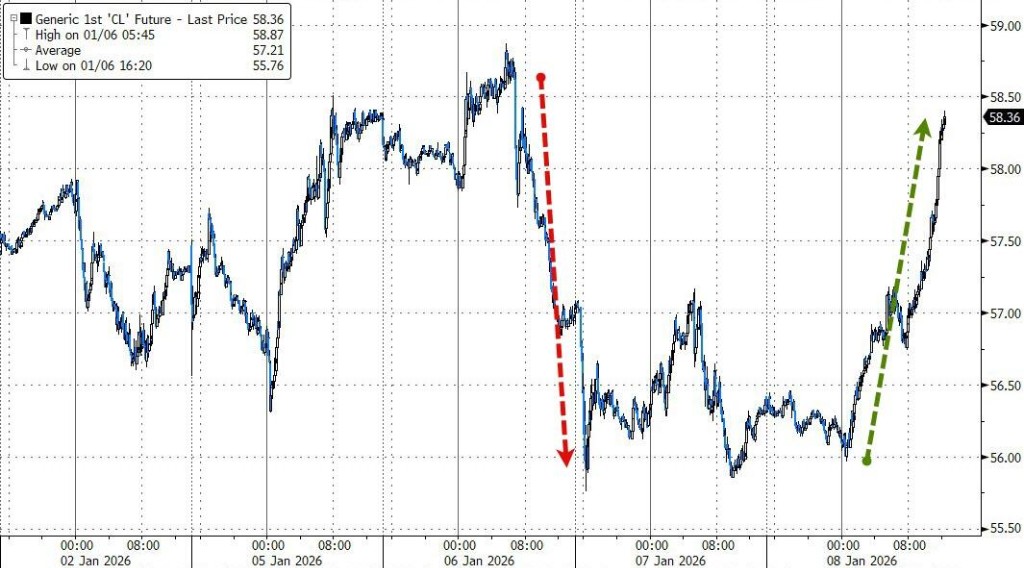
Due to the situation in Venezuela and supply concerns, Brent crude oil surged by 5%, reaching a two-week high

Despite the United States' plan to sell 50 million barrels of Venezuelan crude oil, geopolitical risks are driving oil prices higher. The market's technical support is evident, with CTAs holding a short position of up to 91% in WTI, and a price increase may trigger short covering. Additionally, the rebalancing of commodity indices will bring in capital inflows, and the increased skew of call options indicates that traders are strengthening their hedges
International oil prices rebounded on Thursday after two consecutive days of decline, with Brent crude oil rising by as much as 5%, reaching a two-week high.
Despite the U.S. planning to sell up to 50 million barrels of Venezuelan crude to domestic refiners, and an increase in U.S. gasoline and distillate inventories, investor assessments of the situation in Venezuela and concerns over supply disruptions from Russia, Iraq, and Iran pushed oil prices higher.
On Wednesday local time, U.S. Energy Secretary Chris Wright stated in a media interview that Chevron is expected to rapidly expand its operations in Venezuela, and ConocoPhillips and Exxon Mobil are also seeking to play a constructive role. However, energy consulting firm Ritterbusch and Associates pointed out:
The influx of Venezuelan crude into the U.S. Gulf Coast may take years.
The market is also closely monitoring supply risks from other major oil-producing countries. Reports indicate that a tanker heading to Russia was attacked by drones in the Black Sea, Iraq is advancing the nationalization of the West Qurna 2 oil field due to U.S. sanctions on Russia's Lukoil, and Iran is facing nationwide protests and internet blackouts due to economic difficulties.

On Thursday, the settlement price of Brent crude oil futures rose by $2.03, an increase of 3.4%, to $61.99 per barrel. This is the highest closing price for Brent crude since December 24 of last year. WTI crude oil futures rose by $1.77, an increase of 3.2%, to $57.76 per barrel.
Geopolitical Risks Intensify
Trump's tough stance on Iran has become one of the factors driving up oil prices.
According to CCTV News, President Trump threatened that if the Iranian government kills protesters during the ongoing turmoil, the U.S. will "strongly" strike Iran.
Amid the ongoing unrest in the country, any actual action against Iran could disrupt its oil supply. For a market currently expecting an oversupply, a disruption in Iranian supply would constitute an unexpected supply-side shock.
The technical aspects of the market also support rising oil prices. Data from Bridgeton Research under Kpler shows that short positions held by trend-following commodity trading advisors (CTAs) in WTI account for as much as 91%. This position structure means that once prices surge, traders may be forced to quickly cover their shorts.
Additionally, the annual rebalancing of commodity indices is expected to bring funds back into the oil market in the coming days, providing additional support for prices. The skew of bullish options for Brent crude oil has also strengthened, with traders flocking to the options market for hedging