


Prohibition on institutions "buying houses" and restrictions on military industry "dividends," Trump's posts stir up the US stock market

On Wednesday, Trump released significant policy signals through social media, proposing to prohibit large institutional investors from purchasing single-family homes and warning defense contractors to limit dividends and buybacks. This move led to a nearly 10% plunge in real estate stocks such as Blackstone, while defense stocks rebounded after a sell-off due to a proposed $1.5 trillion budget. Despite the market's violent fluctuations, Wall Street analysts generally questioned the feasibility of Trump's housing ban
Several posts on social media have once again exposed Wall Street to the severe turbulence caused by policy uncertainty.
On January 7th (Wednesday) local time, U.S. President Donald Trump released a series of policy statements regarding housing and the defense industry through social media platforms, triggering significant fluctuations in the U.S. stock market.
Trump first announced that he would "immediately" take action to prohibit large institutional investors from purchasing more single-family homes and urged Congress to legislate this, aiming to address housing affordability issues. This news quickly sparked market panic, leading to a sell-off of related stocks, including those of private equity giants and large home rental companies. He then turned his attention to defense contractors, warning them that they must not pay dividends or buy back stocks before accelerating production and maintenance.
However, market sentiment reversed after the close. After defense stocks fell due to comments about restricting dividends, Trump posted again stating that the military budget for 2027 should reach $1.5 trillion, a piece of good news that drove related stocks to rebound in after-hours trading. This "carrot and stick" strategy left traders feeling bewildered.
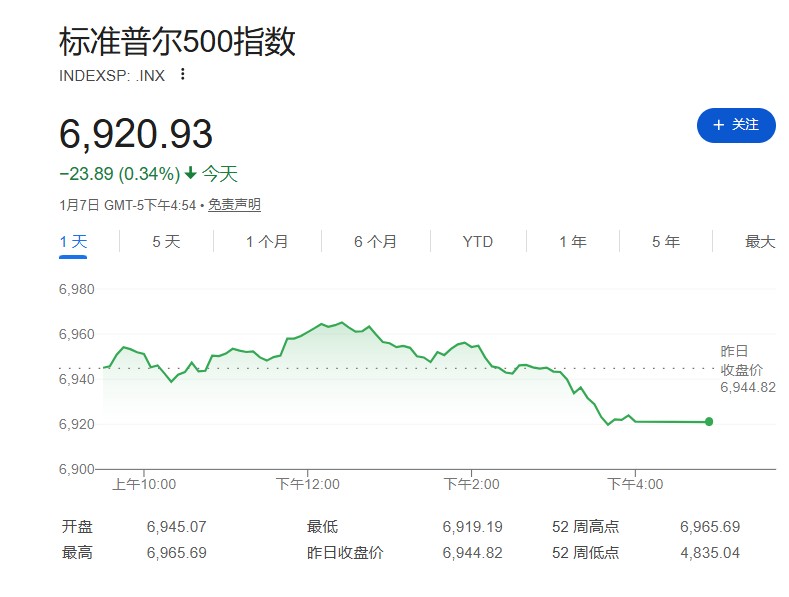
This series of sudden announcements disrupted the calm of the U.S. stock market in the early session, with the S&P 500 index nearing the 7000-point mark around midday but ultimately closing down 0.3%. Investors are trying to discern whether these statements represent a substantive policy shift or are merely Trump's usual negotiation tactics.
Institutional Ban on "Buying Homes" Hits Real Estate Stocks Hard
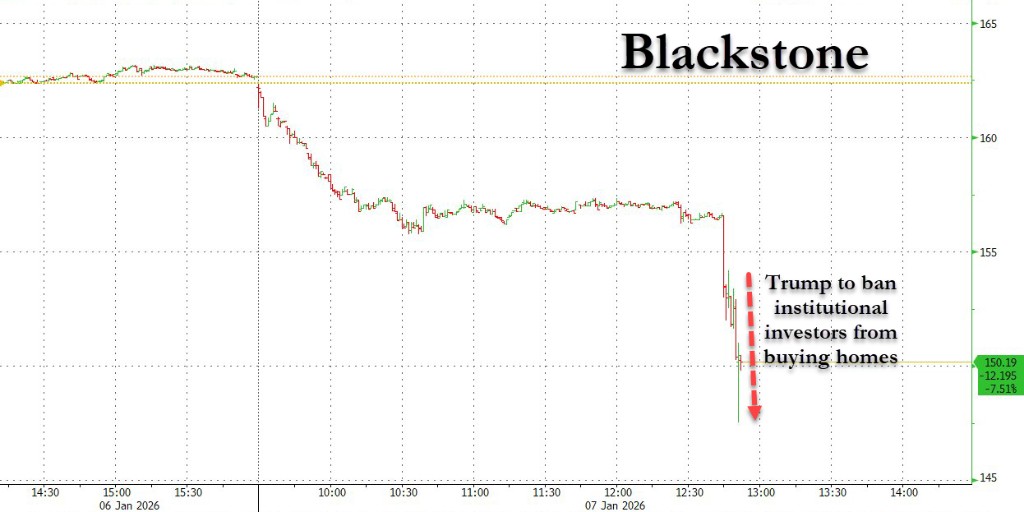
At 12:45 PM New York time on Wednesday, Trump posted that he would take measures to prohibit institutional investors from purchasing single-family homes. Trump stated on the social platform Truth Social: "Houses are for people to live in, not for companies to occupy." He promised to urge Congress to pass relevant legislation and plans to discuss this topic at the World Economic Forum in Davos later this month.
For a long time, buying and owning a home has been seen as the pinnacle of the American Dream—it's the reward for hard work and doing the right thing. But now, due to record-high inflation caused by Joe Biden and Congressional Democrats, this American Dream is becoming increasingly difficult to achieve, especially for young Americans.
People live in houses, not companies.
The market reacted sharply, with the stock prices of companies perceived to have higher risk exposure plummeting.
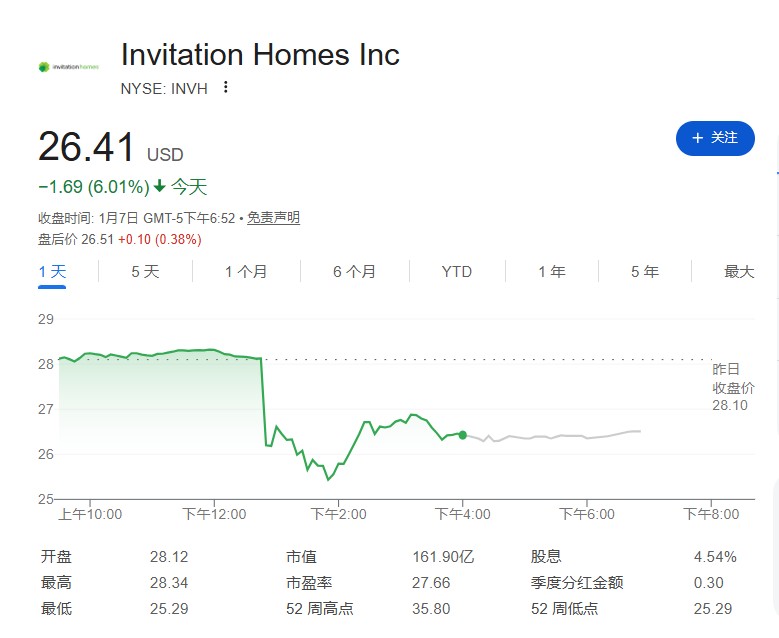
As a major investor in the residential real estate sector, Blackstone's stock price fell as much as 9.3% during the day, ultimately closing down 5.6%. Invitation Homes Inc., the largest owner of single-family rental homes in the U.S., saw its stock price drop 10% at one point, closing down 6%. Additionally, American Homes 4 Rent fell 4.3%, and building materials company Builders FirstSource Inc. dropped 5.6%. The S&P 1500 Residential Building Index fell 2.6%, with 15 of its 18 constituent stocks closing lower
Jeffrey Langbaum, a senior real estate analyst at Bloomberg Industry Research, stated: "He clearly has some means at his disposal to try to do what he says, which will make life difficult for these companies. When you stand on the side of helping individuals buy homes more easily and only need to blame large institutions, this narrative has a market."
Defense Stocks: From Dividend Restrictions to Budget Benefits
Less than an hour and a half after posting about the housing market, Trump turned his attention to the defense industry. In a post in the afternoon, he warned that defense contractors would not be allowed to pay dividends, buy back stock, or pay executives more than $5 million unless they accelerated the production and maintenance of military equipment.
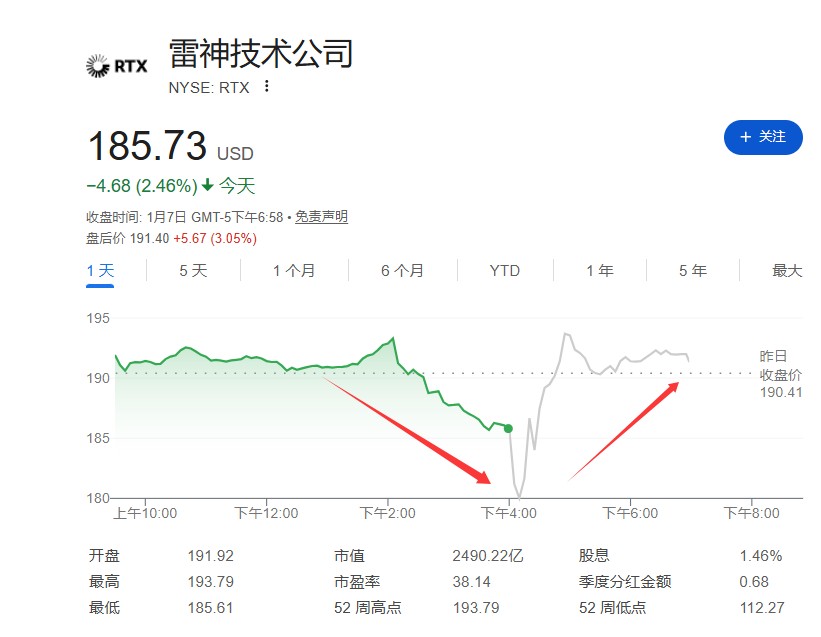
Reports indicate that Trump specifically named RTX Corp. (formerly Raytheon Technologies), threatening to stop doing business with the company unless it increased investment in production capacity. RTX's stock price fell 2.5% during regular trading hours and dropped as much as 6% in after-hours trading.
However, this decline did not last long. Shortly after the regular trading session ended, Trump posted again, calling for next year's defense budget to be $1.5 trillion. This massive budget figure quickly boosted market sentiment, allowing defense stocks to recover in after-hours trading.
Art Hogan, chief market strategist at B Riley Wealth, stated: "The market struggles to digest these things at the speed that social media conveys information. The president's internal thoughts are released without any buffer, and the market trying to adapt to this process will be dangerous."
Wall Street Questions Policy Feasibility and Actual Effects
Despite the market's strong reaction, Wall Street analysts are skeptical about the actual effects and feasibility of Trump's housing ban.
According to data from SFR Analytics, the impact of institutional investors on home buying opportunities is often exaggerated. The top 24 single-family rental home owners collectively own about 520,000 homes, accounting for only about 3.5% of the 15 million rental homes in the U.S., and less than 1% of the total stock of single-family homes.
In a statement, Blackstone responded: "The single-family homes we own in the U.S. account for only about 2% of our real estate assets under management, and 0.5% of the company's overall size. Moreover, we have been net sellers of homes over the past decade." Realtor.com's senior economist Jake Krimmel pointed out in a report that completely driving institutional investors out of the market is unlikely to make housing prices more affordable. He believes, "The affordability crisis is fundamentally a supply issue. Large corporate ownership is just a red herring in the broader supply debate."
Joe Gilbert, portfolio manager at Integrity Asset Management, also expressed skepticism: "First, we doubt this can be enforced. Second, while institutional buyers have increased, they are not the marginal buyers. We believe this poses a bearish outlook for housing prices in the short term, but we do not think it is enough to solve the affordability issue for homebuyers."
Jeffrey Rubin, president of Birinyi Associates Inc., believes this may just be Trump's negotiation strategy, "If his threats come true, it would be a huge shift, but the ultimate outcome remains to be seen."
