Downward adjustment! Multiple banks have reduced wealth management fees to 0%

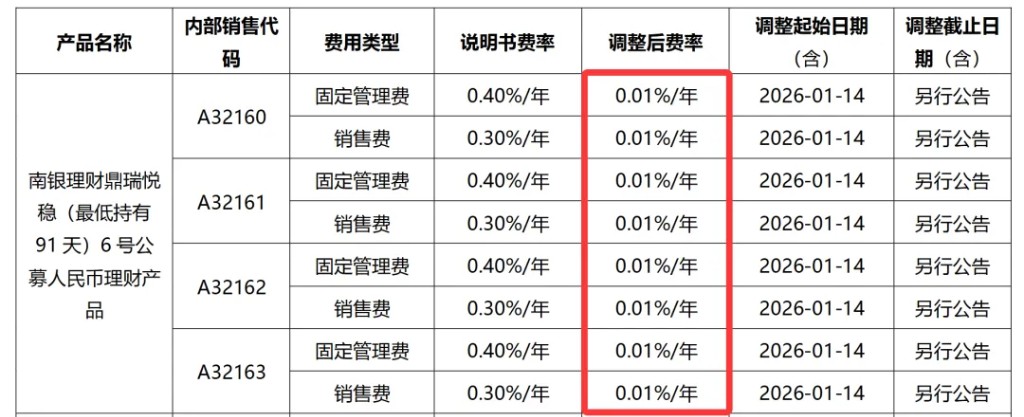
Multiple banks' wealth management subsidiaries have announced a reduction in management fees. Nanyin Wealth Management has lowered the fixed management fee for some products from 0.4% to 0.01% and the sales fee from 0.3% to 0.01%, effective from January 14. Jianxin Wealth Management has also implemented preferential management fee rates for some products, while Ningyin Wealth Management has reduced the sales service fee for several products to 0.00%. ZYBANK has adjusted the investment management fee and sales service fee for some wealth management products to 0.00%. Over the past year, the fee rates for wealth management products have generally decreased
Bank wealth management subsidiaries have once again initiated a "fee reduction wave."
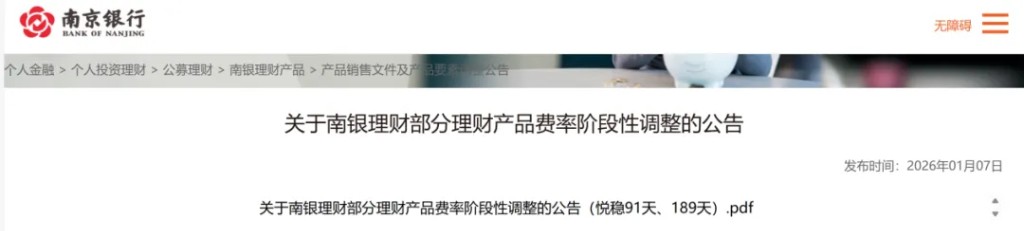
On January 7, Nanyin Wealth Management announced adjustments to the fixed management fees and sales fees for its Yuewen series products with holding periods of 91 days and 189 days.

Nanyin Wealth Management reduced the fixed management fee for the aforementioned products from 0.4% to 0.01%, and the sales fee from 0.3% to 0.01%. The adjusted rates will take effect from January 14. This means that for a purchase of 10,000 yuan in wealth management products, the fixed management fee drops from 40 yuan to 1 yuan, and the sales fee drops from 30 yuan to 1 yuan.

On the same day, Jianxin Wealth Management announced plans to offer preferential management fee rates for certain products. Among them, the management fee for the "Jianxin Wealth Management Jiaxin (Stable Profit) Corporate Version Fixed Income Daily Open-ended Product Phase 15 (Zhejiang Exclusive)" and "Jianxin Wealth Management Jiaxin (Stable Profit) Corporate Version Fixed Income Daily Open-ended Product Phase 13 (Shenzhen Exclusive)" will be 0.01% per year after the discount.
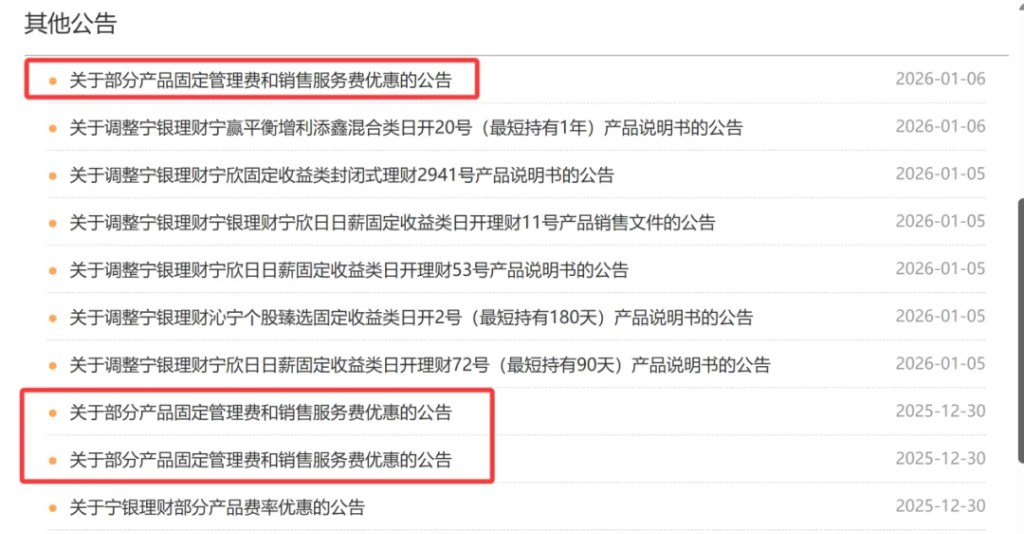
Previously, Ningyin Wealth Management issued multiple announcements from December 26, 2025, to January 6, 2026, providing certain discounts on the fixed management fees, sales service fees, and floating management fees for several of its wealth management products.

One announcement indicated that the sales service fee for the "Ningyin Wealth Management Ningxin Fixed Income" series of 12 products was reduced from 0.30% (annualized) to 0.00%. The discount period is from January 1, 2026, to December 31, 2026. Additionally, the floating management fees for 8 products in the Ningxin Fixed Income series were also reduced to 0.00%.
On January 4, ZYBANK announced that the investment management fees and sales service fees for its "ZYBANK Stable Growth 2024 Phase 143 Wealth Management Product," "ZYBANK Stable Growth 2025 Phase 76 Wealth Management Product," and "ZYBANK Stable Growth 2025 Phase 107 Wealth Management Product" were all adjusted to 0.00% per year during certain past periods. However, the related products had already expired and terminated on January 6.
In fact, over the past year, many wealth management companies have initiated multiple rounds of phased fee reductions for their wealth management products, resulting in a significant decrease in fee levels compared to before. For example, in July 2025, more than 10 wealth management companies, including Bank of China Wealth Management, Jianxin Wealth Management, and China Merchants Bank Wealth Management, intensively issued announcements regarding fee adjustments, with management fees dropping by as much as 0.25 percentage points In September, Bank of China Wealth Management announced fee discounts for multiple wealth management products; in October, the company issued another announcement to reduce fees for several wealth management products. Subsequently, several bank wealth management companies, including China Merchants Bank Wealth Management, CCB Wealth Management, ABC Wealth Management, and Pudong Development Bank Wealth Management, also released announcements regarding phased fee discounts, covering areas such as sales service fees, fixed management fees, and custody fees.
The research team led by Mingming from CITIC Securities recently pointed out that the continuous decline in deposit rates has gradually widened the "scissors gap" with wealth management yields, prompting a significant amount of deposit funds to shift towards wealth management products. Against the backdrop of "low interest rates + structural market conditions in the stock market," "fixed income +" products are expected to experience an explosion in 2026, with an anticipated annual growth scale exceeding 1 trillion yuan, becoming the main force driving growth in the wealth management market; the total scale of wealth management is expected to surpass 35 trillion yuan for the year.
Industry insiders indicate that the fee adjustments for bank wealth management products are primarily focused on phased fee reductions to enhance product attractiveness; at the same time, the overall downward pressure on industry fees is increasing, and maintaining competitiveness through fee reductions or differentiated services is expected, with more products likely to follow suit in adjustments in the future.
However, the financial data platform Puyi Standard has mentioned in its research report that small and medium-sized wealth management companies, constrained by operational costs and revenue pressures, may find it difficult to maintain such ultra-low fees in the long term. In the long run, ultra-low fee products may become a normalized strategy for leading wealth management companies, but widespread adoption in the industry still needs to be based on the specific circumstances of the institutions, with the core focus remaining on balancing costs and revenues.
China Fund News
Risk Warning and Disclaimer
The market has risks, and investment requires caution. This article does not constitute personal investment advice and does not take into account the specific investment goals, financial conditions, or needs of individual users. Users should consider whether any opinions, views, or conclusions in this article align with their specific circumstances. Investing based on this is at one's own risk