Eurozone December CPI slows to 2%, market expects ECB to remain "on hold" for a long time

Wallstreetcn
2026.01.07 11:36
portai
I'm PortAI, I can summarize articles.

The inflation rate in the Eurozone has fallen to the European Central Bank's target of 2% in December, and core inflation continues to slow down, reinforcing market expectations that interest rates will remain unchanged at current levels. Although there are still pressures from service inflation and wage growth, unless there is a significant change in the economic outlook, the European Central Bank is expected to maintain its policy unchanged in the foreseeable future, with only a slight increase in market bets on interest rate cuts

The inflation rate in the Eurozone has fallen to the European Central Bank's target level of 2%, a key data point that further solidifies policymakers' core view: current interest rates will be maintained unless there is a significant change in the economic outlook.

According to preliminary data released by Eurostat on Wednesday, the consumer price index (CPI) in December rose by 2% year-on-year, down from the previous value of 2.1%, in line with economists' expectations in a Reuters survey. Excluding volatile food and energy costs, the core inflation rate slowed from 2.4% in November to 2.3%, while the closely watched services inflation rate also decreased from 3.5% to 3.4%.

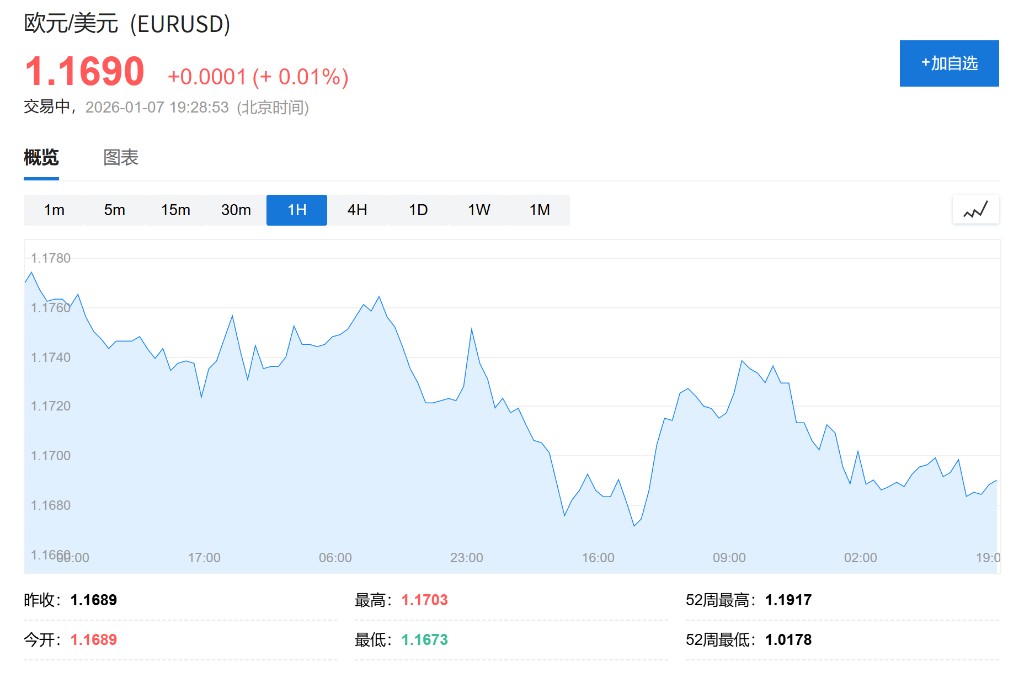
Following the data release, market reactions were relatively muted. The euro erased earlier losses against the dollar, holding steady around 1.169, and the Stoxx 600 index showed no significant fluctuations.

Although the return of inflation to target may provide a rationale for future rate cuts, traders only slightly increased their bets on monetary easing, with pricing indicating a rise in the likelihood of a rate cut of about 5 basis points by September this year, which corresponds to a roughly 20% probability of another 25 basis point cut.

Price growth has hovered around the 2% target for more than six months, allowing the European Central Bank to keep borrowing costs unchanged at its last four meetings since the last rate cut in June, with the key deposit facility rate currently at 2%. Economists and investors generally expect that the central bank will not take further policy action in the foreseeable future.

Inflation Divergence and Wage Pressure

While the overall slowdown in inflation meets expectations, there are still significant differences in the pace of price growth within the Eurozone. Data shows that Spain's inflation rate has dropped to 3%, Germany to 2%, while France has slowed to 0.7%.

In specific sectors, services inflation remains a primary concern for the European Central Bank. Although December's data showed a decline, part of the reason was the drop in volatile airfare prices. Deeper pressures come from wage growth. Data indicates that the broadest wage growth indicator remained at 4% in the third quarter, a level still considered above what is consistent with price stability.

European Central Bank President Christine Lagarde stated last month that while wages have largely caught up after the post-pandemic price surge, a moderation is expected this year, but the central bank still needs to "carefully observe relevant trends." According to David Powell, a senior Eurozone economist at Bloomberg Economics, the slowdown in December inflation is good news for the European Central Bank, but it is primarily driven by energy costs and may not be closely related to monetary policy.

Policymakers' Stance and Market Outlook

Most policymakers believe inflation is under control, but given the persistent uncertainty in the global economy, they remain cautious about the next steps. Although Morningstar's chief equity strategist Michael Field noted in a comment that **low and stable inflation may prompt the central bank to lean towards stimulus measures sooner, which is a positive signal for the stock market, mainstream institutions have not changed their assessment of the interest rate path **

Nordea analysts Anders Svendsen and Tuuli Koivu pointed out in their report: “ We maintain our long-term view that the European Central Bank will keep interest rates unchanged in 2026. The risks in the first half of the year lean towards rate cuts, while long-term risks lean towards rate hikes. This is consistent with market pricing, and today’s inflation data should not change this view.”

Long-term Forecast and Potential Risks

The European Central Bank predicted in its last meeting of 2025 that this year's inflation rate would be slightly below the target level due to the slower pace of service cost reductions. According to the central bank's baseline scenario, the average inflation rate is expected to be 1.9% in 2026, followed by a further decline, and then rising back to 2% in 2028.

However, there are still several external factors that could cause inflation to deviate from the target. Potential risks include the yet-to-be-fully-realized effects of U.S. tariff policies, a strong euro, and potential fiscal expansion policies that Germany may implement. Additionally, senior officials of the European Central Bank revealed to CNBC that the easing cycle is nearing or at its end, and the central bank will continue to adhere to a data-dependent decision-making approach at successive meetings