


How the mobile business responds to memory risks, AIoT, electric vehicles, and research and development layout... Understand the speech of Xiaomi executives at the Goldman Sachs conference in one article

Xiaomi has established that its primary focus for 2026 is to increase the selling price of its smartphones, responding to rising memory costs through premiumization and price hikes. The company has set an annual delivery target of 550,000 electric vehicles. Additionally, Xiaomi plans to invest HKD 200 billion in research and development over the next five years, focusing on AI, intelligent driving, and self-developed chips to integrate the "person × vehicle × home" ecosystem, with overseas AIoT business seen as a future growth engine. Goldman Sachs maintains a "Buy" rating with a target price of HKD 53.5
Xiaomi is prioritizing the increase of its average smartphone selling price as its primary operational focus for 2026, while significantly boosting investments in artificial intelligence to transform its entire business line and setting an annual delivery target of 550,000 electric vehicles. The world's third-largest smartphone brand is driving multi-year expansion through its "people × car × home" ecosystem strategy.
On January 7th, according to news from the Chasing Wind Trading Platform, Goldman Sachs' latest research report revealed that on January 5-6, 2026, Goldman Sachs held a conference call with Chinese automotive management, where Xiaomi executives detailed the company's latest strategic layout in three major sectors: smartphones, AIoT, and smart electric vehicles.
The report stated that Xiaomi's General Manager of Investor Relations and senior managers indicated during the call that Xiaomi is executing an extremely aggressive but clearly defined capital expenditure plan (with a research and development budget of up to 200 billion RMB from 2026 to 2030), aiming to connect the "people x car x home" ecosystem through underlying technologies (self-developed chips, AI large models).
The report pointed out that Xiaomi executives mentioned that although they face macro headwinds from soaring storage chip costs in the short term, management is attempting to hedge risks through premiumization and price increases, as well as supply chain management. Meanwhile, the AIoT sector aims for growth, with plans to expand stores to over 1,000, and overseas AIoT business is seen as a future growth engine.
Goldman Sachs stated that Xiaomi executives emphasized that the most critical catalyst lies in the scale effect release of the electric vehicle business (with the delivery target raised to 550,000 units for 2026) and the potential of self-developed chips to replace external suppliers (such as NVIDIA).
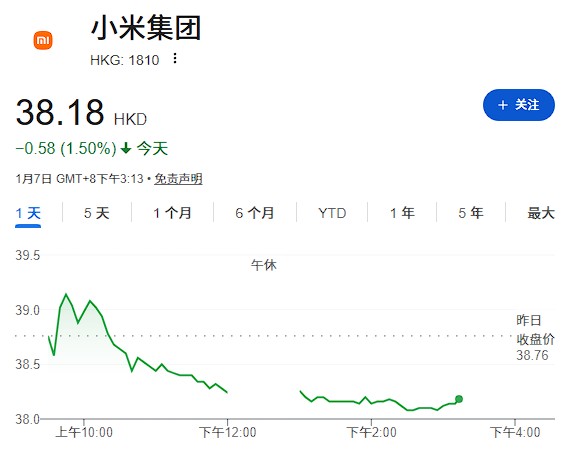
Goldman Sachs maintains a "Buy" rating on Xiaomi, with a target price of HKD 53.5, representing nearly a 40% upside from the current HKD 38.18.
Mobile Business: Price Increases to Counter Cost Tsunami, Premiumization is the Only Way Out
The report stated that Xiaomi executives indicated that in the face of the entire industry experiencing a shortage of storage chip supply and soaring costs, Xiaomi's strategy is no longer purely defensive but aims to shift pressure by increasing the average selling price (ASP).
Firstly, Xiaomi executives clearly stated that the primary operational focus for 2026 is to increase the average selling price of smartphones. The specific method is simple, straightforward, but effective: price increases. For example, the upcoming Xiaomi 17 Ultra will be priced 500-700 RMB higher than the Xiaomi 15 Ultra.
In response to rising memory prices, Xiaomi executives admitted that the current memory price upcycle is "unprecedented." The upward price trend is expected to continue in the first half of 2026, with a possible slowdown in the second half, but considering the explosive demand for AI, visibility for 2027 remains limited.
Xiaomi executives stated that compared to pure smartphone OEM manufacturers, Xiaomi's advantages lie in its large order volume and diversified business structure. If memory costs return to normal in the medium term, there will be significant room for improvement in gross profit margin (GPM).
At the same time, Xiaomi executives emphasized that the Chinese market holds high strategic importance for Xiaomi and is the starting point for its premiumization strategy. The company's goal is to increase its market share in the Chinese market by 1 percentage point each year. **
AIoT: The "Ballast" of Profit, Overseas Expansion as the Growth Engine
According to the research report, the AIoT sector, along with internet services, is positioned as Xiaomi's profit stabilizer. Based on achieving approximately 20% year-on-year revenue growth and a gross margin expansion of 2-2.5 percentage points by 2025, Xiaomi executives expect growth in 2026 to be driven by government subsidies for consumer electronics and home appliances, as well as overseas expansion.
The company's goal is to increase the number of Xiaomi Home stores from about 500 in 2025 to over 1,000 in 2026, while expanding product categories and exploring cooperation with cross-border e-commerce platforms like AliExpress. Management pointed out that currently, overseas AIoT revenue accounts for about 30% (Q3 2025 data), while overseas mobile phone revenue has reached 60%. The company views the latter as a reference target for the long-term potential of AIoT business overseas.
By category, large home appliances account for about 20% or more of revenue, marking a strategic business since 2023; televisions and PCs account for 15-20%; tablets about 15%; wearable devices about 10%, with the remainder contributed by a wide range of ecosystem products.
The company plans to maintain the gross margin in 2026 at no less than the level of 2025 by cutting low-margin categories, increasing self-developed products, and avoiding aggressive discounts.
Smart Vehicles: Delivery Target Aggressively Raised to 550,000 Units, Third Model Critical for Survival
Goldman Sachs stated that the ramp-up speed of Xiaomi's automotive production capacity exceeds market expectations. Xiaomi has announced a delivery target of 550,000 units for 2026, a significant increase compared to the over 410,000 units expected in 2025 (which has surpassed the initial target of 300,000 set in January and the revised targets of 350,000 and 400,000 in March and year-end).
Xiaomi executives stated that the growth momentum comes from the supply side's manufacturing capacity enhancement and the demand side's confidence in the SU7 facelift model (to be delivered in the first half of 2026) and the third model based on the new platform (to be delivered in the second half of the year).
As manufacturing capacity keeps pace, the company will increase consumer incentives and marketing efforts. The third model will target a different user group than the SU7/YU7, and management expresses strong confidence in its success.
Management believes that a healthy gross margin level for smart electric vehicles is over 20%, achievable through supply chain management capabilities, blockbuster product methodologies, and high efficiency in new retail channels. However, the gross margin in 2026 may be lower than in 2025 due to:
The impact of purchase tax subsidies (Xiaomi offers a maximum purchase tax subsidy of 15,000 yuan for orders locked before November 30, 2025, and delivered in 2026) and the declining proportion of SU7 Ultra deliveries.
The research report pointed out that Xiaomi reiterates its focus on the high-end automotive market, as models priced above 150,000 yuan account for 50% of China's annual passenger car sales of 20 million, but capture 80-90% of the industry's total profits. High-end electric vehicles are driving Xiaomi's brand upscale and support its long-term goal of becoming one of the top five automotive platforms globally within 15-20 years. The company plans to start exporting electric vehicles to Europe in 2027, viewing Europe as a unified and high-end market.
R&D Investment: Advancing in AI, Assisted Driving, and Chips
Goldman Sachs stated that Xiaomi executives mentioned in a conference call that Xiaomi is committed to investing RMB 200 billion in R&D from 2026 to 2030, mainly focusing on AI, intelligent driving, and chip fields.
AI investment accounts for about 25% of Xiaomi's RMB 320-330 billion R&D expenditure in 2025, which is RMB 80 billion. Although the company plans to increase AI investment in 2026, management will maintain a reasonable level, believing that current computing resources are sufficient.
Xiaomi aims to leverage AI to empower its ecosystem (as the only smartphone brand with its own foundational large model) and internal operations (with 30% of code generated by AI), rather than selling AI capabilities to third parties.
In terms of assisted driving, Xiaomi has 1,800 professionals, and the enhanced HAD (Highly Automated Driving) version released in November 2025 incorporates reinforcement learning and world models based on a version trained on 10 million video clips released in June.
As of 2025, 91.26% of Xiaomi electric vehicle users are active users of assisted driving. The company plans to launch VLA assisted driving in 2026 and obtain L3 autonomous driving road test licenses in Beijing by the end of 2025.
Regarding chip investment, Xiaomi has announced an investment of RMB 50 billion over ten years starting from 2021, with RMB 13.5 billion invested in the development of the XRING O1 chip over the past four years.
With the release of the self-developed XRING O1 chip in mid-2025, which has 3nm SoC design capabilities, the company is confident in its self-developed smart electric vehicle chips (compared to the NVIDIA DRIVE AGX Thor chip currently used in YU7)
