


"Tarroism" monetization? Chevron urgently dispatches 11 oil tankers to seize Venezuelan crude back to the United States

Under the framework of "Tangluoism," the United States accelerates the monetization of Venezuela's energy interests through direct intervention. Vessel dynamics show that one of the 11 oil tankers leased by Chevron has completed loading, and two others are currently docked at the port. As a result, international oil prices have fallen due to reduced supply risks. Analysts predict that if Venezuela's production rebounds to 1.3 million barrels per day, it will continue to pressure oil prices, but infrastructure repair will still require substantial investment and long-term construction
As the Trump administration transforms geopolitical influence into actual energy benefits, Venezuela's oil resources are accelerating their flow to the U.S. mainland. Under the so-called "Trumpism" policy framework, the U.S. is reshaping the energy landscape of the Western Hemisphere through direct intervention, characterized by a shift from sanctions and blockades to a U.S.-led redistribution of resources.
According to CCTV News, on January 6 local time, U.S. President Trump announced that the Venezuelan interim government would transfer 30 to 50 million barrels of oil to the U.S. Meanwhile, market data shows that physical logistics have already started, vessel dynamics indicate that one of the 11 tankers leased by Chevron has completed loading, and two others are currently docked at the port. All crude oil will be sent to U.S. refineries, including Valero Energy Corp, Phillips 66, and Marathon Petroleum Corp. This number of leased vessels has reached a new high since October last year, increasing from 9 vessels in December.
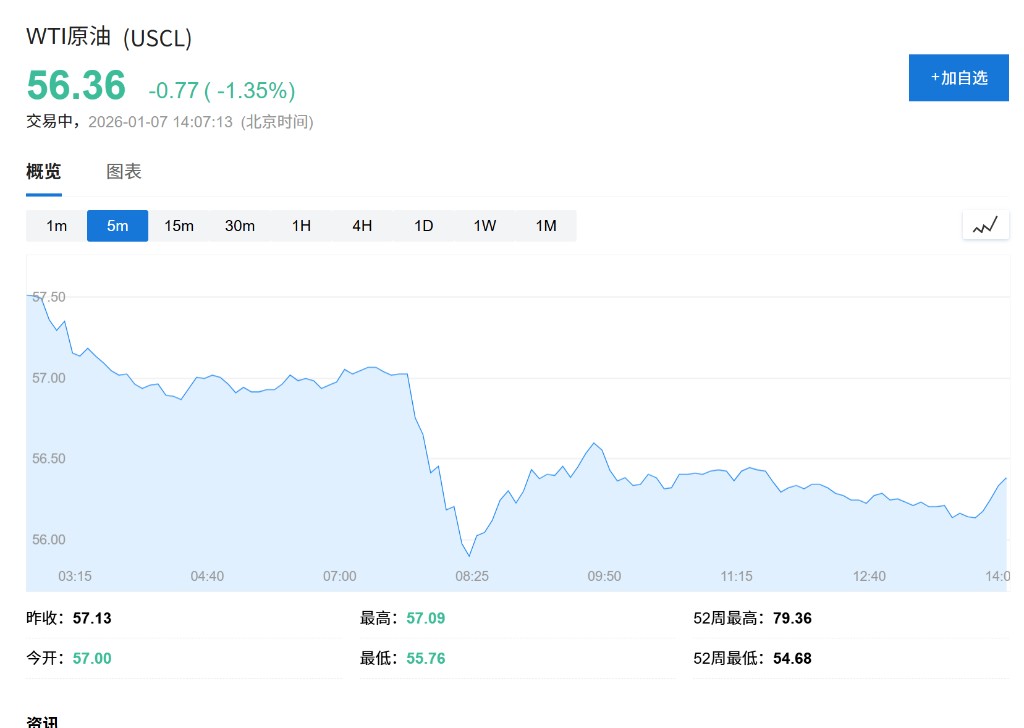
In response to this news, international crude oil prices fell sharply. The market generally believes that as the U.S. takes over the situation in Venezuela, the risk of further collapse in the country's oil production decreases, and exports to the U.S. will significantly increase in the short term, thereby alleviating supply-side tensions.
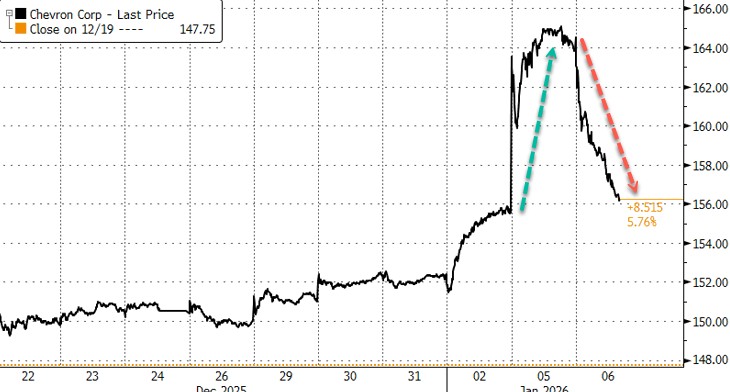
In the U.S. stock market, although the stock prices of Chevron, ConocoPhillips, and ExxonMobil surged on Monday due to news of the regime change, on Tuesday, as the market began to reassess the complexities of long-term recovery, Chevron gave back most of its gains.
Monetization of Energy under "Tang-Luoism"
According to comments cited by Global Times, the Trump administration has upgraded the traditional "Monroe Doctrine" to a more aggressive "Tang-Luoism." This new strategy explicitly designates the Western Hemisphere as the "core interest zone" of the United States and authorizes the use of military force for direct intervention, aiming to eliminate the influence of other major powers in the region. From attacking Venezuela to threatening Colombia and Mexico, the U.S. has blatantly transformed "America for Americans" into "America for Americans." The forced transfer of Venezuelan oil is seen as a direct example of this doctrine's "monetization."
Media commentary indicates that this geopolitical shift has not surprised the market. With U.S. special forces operating in Caracas, America's control over the Western Hemisphere has significantly strengthened. Against this backdrop, the previously sanctioned Venezuelan crude oil inventory is turning into a cheap raw material source for the U.S. refining system.
In this changing situation, Chevron, with its unique market position in Venezuela, has become the undisputed winner among U.S. oil giants. Data shows that of the 11 tankers leased by Chevron, 1 has completed loading, and 2 are currently docked, marking the highest number of leased vessels since last October.
As the only Western company still holding a U.S. Treasury license to produce and export crude oil in Venezuela under sanctions, Chevron possesses operational and regulatory "moats" that its competitors cannot match. This batch of crude oil shipped to the U.S. will primarily supply American refiners, including Valero Energy Corp, Phillips 66, and Marathon Petroleum Corp.
Investment Bank Perspective: Supply Risks Lowered, Prices Under Pressure
Regarding the direct impact of the Venezuelan situation on the oil market, Wall Street investment banks generally hold a cautiously optimistic view, believing this will exert short-term downward pressure on oil prices.
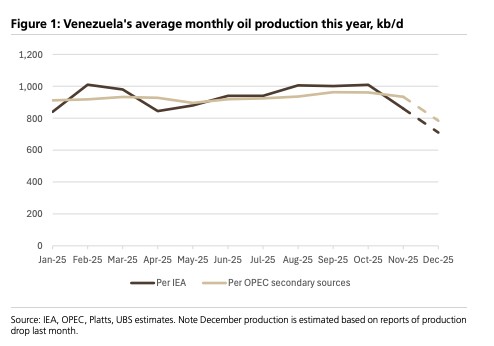
UBS analyst Henri Patricot pointed out that although the U.S. embargo on Venezuela remains nominally effective, recent events have reduced the risk of continued production decline in the country, and may even lead to a rapid rebound in output. UBS expects that if restrictions are lifted, Venezuelan production could quickly rebound from the current approximately 850,000 barrels per day to 1 million barrels per day, or even reach 1.2 to 1.3 million barrels per day. This potential supply increase will pose additional headwinds for the oil market in 2026.
Goldman Sachs analyst Daan Struyven's team maintains its forecast of an average Brent crude oil price of $56 per barrel for 2026, but notes that the situation in Venezuela presents downside risks. Goldman estimates that if Venezuelan crude oil production increases by 400,000 barrels per day before the end of 2026, the average Brent crude oil price could drop to $54 per barrel (below the baseline forecast of $56); Conversely, if production declines, the average price may rise to $58 per barrel. In the long term, if the country's production recovers to 2 million barrels per day by 2030, it will bring a downward space of $4 per barrel to oil prices.
The Road to Recovery Still Faces Structural Challenges
Despite a surge in short-term exports, analysts warn that the comprehensive recovery of Venezuela's oil industry faces significant structural obstacles. UBS emphasized that restoring production levels to 2.5 million barrels per day, as seen a decade ago, may require up to 10 years and substantial capital investment.
Unlike Iran, Venezuela's oil infrastructure has been severely damaged due to years of underinvestment. Although Trump claimed that U.S. oil companies would "spend billions of dollars to repair the infrastructure," UBS pointed out that this requires a high degree of political stability as a prerequisite. Looking back at the precedents in Iraq and Libya, restoring production capacity after a regime change is often fraught with challenges.
Additionally, media analysis indicates that as the U.S. strengthens its control over the Western Hemisphere, the "shadow fleet" originally used to evade sanctions and transport Venezuelan oil will suffer severe blows. This portion of capacity accounts for about 10% of the global tanker fleet used for transporting sanctioned crude oil, and its business contraction will pose a negative impact on buyers relying on these clandestine supply channels.
At the macro supply level, OPEC+ has maintained a wait-and-see attitude in this changing situation. The eight countries implementing voluntary production cuts confirmed on Sunday that they would suspend the planned production increases for February and March, a decision that aligns with market expectations and has not had a significant additional impact on oil prices
