The Advancing Insurance: Not Just a Transaction "New Year Opening", Long-term Bonds at 2% Threshold and Returning to 1x P/EV

On January 5, 2026, the insurance sector surged over 6%, with NCI and CPIC reaching all-time highs. Analysts believe that the insurance sector has experienced a cyclical logic of "improved expectations for the New Year - long-term interest rates rebounding - index rally strengthening profit elasticity." It is expected that the new business growth rate of listed insurance companies in the first quarter of 2026 will be 30%, with the growth rates for bancassurance and individual insurance at 50% and 20%, respectively. Attention should be paid to signals of long-term interest rates breaking through 2.0%, as there are divergences in the market regarding the trend of ten-year government bond yields
Report Summary
Event: On January 5, 2026, the insurance sector surged over 6%, with New China Life Insurance and China Pacific Insurance reaching historical highs. We believe that since December of last year, the insurance sector has experienced a cyclical logic of "improved expectations for the New Year - long-term interest rates rebounding - index rally strengthening profit elasticity." From valuation repair to performance realization, we reaffirm the investment value of the sector and recommend continued attention to China Life Insurance, China Pacific Insurance, Ping An Insurance, New China Life Insurance, and China Property & Casualty Insurance.
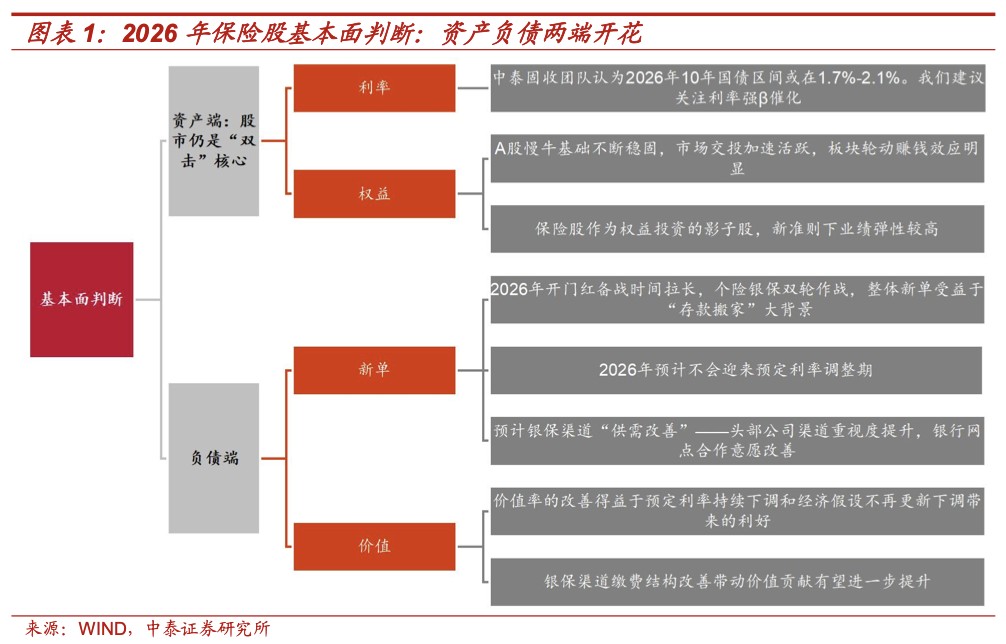
Current stock prices are trading on expectations exceeding the "New Year" performance for 2026, with 1Q26 being the peak for annual value and profit growth. At the beginning of the New Year 2026, the actual data for the New Year performance of listed insurance companies generally exceeded expectations, highlighting the advantages of dividend insurance as a long-term savings alternative in a persistently low interest rate environment. We expect the average new business growth rate for listed insurance companies in 1Q26 to be 30%, with bancassurance and individual insurance growth rates at 50% and 20%, respectively. On one hand, the base for individual insurance's New Year performance in 2025 was relatively low; on the other hand, leading insurance companies are increasingly focusing on bancassurance channels. The expansion of cooperative outlets in 2026, combined with the effectiveness of "lump-sum promoting term," will make the bancassurance channel a decisive factor for new business and value growth throughout the year. Meanwhile, the new business value rate benefits from the cessation of adjustments to the EV economic assumptions, and the widening NBV spread offsets the slight negative impact of the increased proportion of dividend insurance (the new business guaranteed interest rates for traditional and dividend insurance sold in 1Q25/1Q26 are 2.5%/2.0% and 2.0%/1.75%, respectively; under the assumption of maintaining a 4.0% investment return rate, the cost of new business decreases and the spread widens, but this impact will gradually fade after August 2026). In the long term, benefiting from the reallocation of residents' assets due to deposit migration, the growth rate on the liability side is expected to continue, and a slow bull market in equities is likely to strengthen the sales logic of dividend insurance itself.
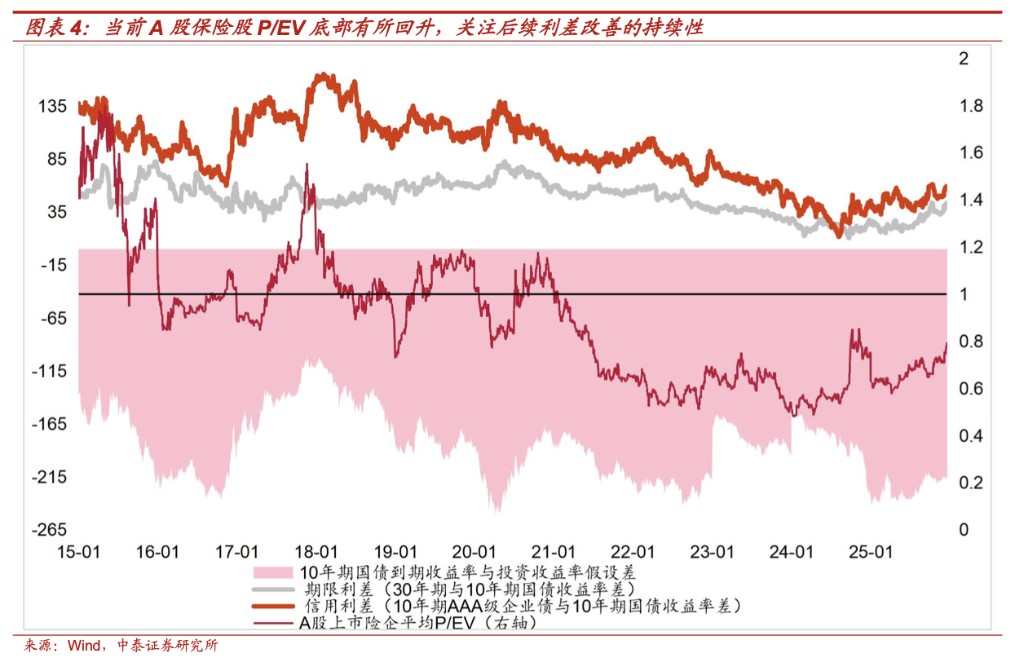
Pay attention to the signal significance of long-term interest rates breaking through the 2.0% integer level. Currently, the market has a mixed expectation for the future trend of the yield on 10-year government bonds, with differing opinions on whether it can continue to break through the 2.0% integer level. We have constructed a framework to observe the reasonableness of the average P/EV valuation of A-share listed insurance companies based on the difference between the yield on 10-year government bonds and investment return assumptions, credit spreads, and term spreads. Looking back, if long-term interest rates break through the 2.0% integer level, it would correspond to a previous investment return assumption of 5.0% relating to about 3.0% (which corresponds to the current 4.0% investment return assumption with the same 200bps spread), and the P/EV valuation is expected to gradually approach 1 time. The Zhongtai Fixed Income team believes that the 10-year government bond yield in 2026 may range from 1.7% to 2.1%, presenting a "mountain" rhythm. Long-term interest rates are easier to rise than to fall; in the context of warming inflation expectations, this is favorable for the recovery of insurance stock valuations. At the same time, we further recommend that investors observe whether credit spreads and term spreads can maintain improvement.
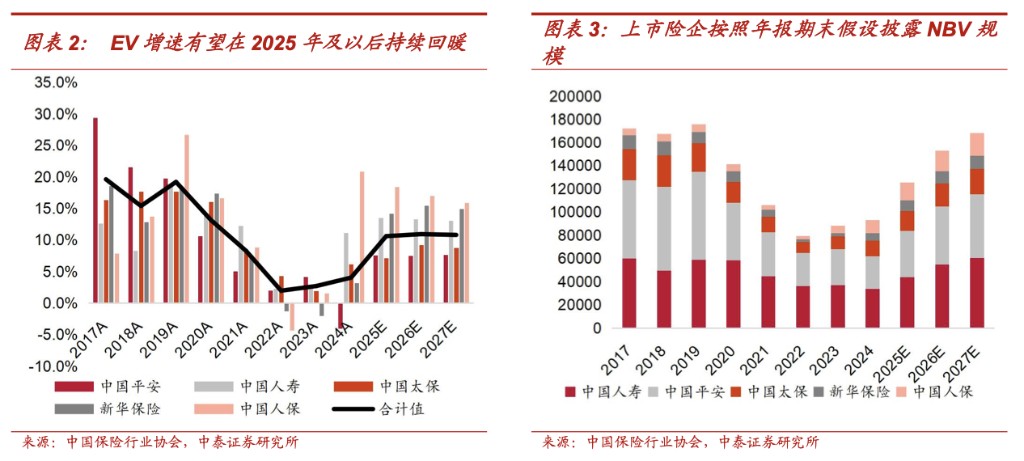
On the path to returning to a 1 time PEV repair, both asset and liability sides are flourishing. Since 2023, after several rounds of updates to the embedded value (EV) economic assumptions, the credibility of EV is gradually warming. We expect that in the 2025 annual report, listed insurance companies will generally not adjust their embedded value economic assumptions, and the EV growth rate will return to restorative growth When valuing life insurance companies using P/EV, investors' expectations for future NBV growth rates are an important reference factor determining the level of valuation. A clear recovery in ROEV can drive valuations back above 1x. We expect the average growth rates of listed insurance companies' EV from 2025 to 2027 to be 10.6%, 10.9%, and 10.8%, respectively; the NBV growth rates are expected to be 34.7%, 21.7%, and 10.0%.
Investment Recommendation: Buy cyclical insurance stocks supported by performance. In 2026, benefiting from the momentum growth of new policies and value, combined with refined management methods to continuously reduce comprehensive liability costs on the liability side, the profitability alpha of insurance companies is expected to further improve, while the asset side (long-term interest rates and stock market) has potential upward catalysts providing clear beta catalysts.
Risk Warning: Long-term interest rate decline, continued poor growth in the New Year’s business, etc.


Risk Warning and Disclaimer
The market has risks, and investment requires caution. This article does not constitute personal investment advice and does not take into account individual users' specific investment goals, financial conditions, or needs. Users should consider whether any opinions, views, or conclusions in this article are suitable for their specific circumstances. Investment based on this is at your own risk