


Metal frenzy! During the trading session, London nickel rose over 9%, New York silver rose over 6%, and London copper hit a new historical high

London nickel recorded the largest intraday increase in over three years, driven by Chinese buying, with nickel prices rising over 20% in two weeks. On Monday, London copper broke through the $13,000 mark for the first time in history during intraday trading, and on Tuesday it rose over 3% during intraday trading, as market expectations of increased tariffs in the U.S. led to inventories being "locked in the U.S." Futures silver surged due to the entry of Chinese retail investors. Geopolitical risks and expectations of interest rate cuts resonated, with New York futures gold rising over 1% during intraday trading, approaching the highest record set before Christmas
This Tuesday, the metal market continued its upward momentum from Monday, experiencing a comprehensive breakout. London nickel led the surge in industrial metals, rising over 9% at one point during the session. New York silver also saw an increase of over 6%, approaching the intraday record set a week ago. After breaking the $13,000 mark for the first time in history on Monday, London copper further climbed, gaining over 3% during Tuesday's session, marking two consecutive days of record highs. New York gold rose over 1%, erasing most of the declines since the Chicago Mercantile Exchange (CME) raised trading margins last Monday, and is nearing the record high set before Christmas.
Chinese investors have become a significant driving force behind this round of metal price increases. Trading dynamics show that metal prices, including nickel, copper, and tin, surged significantly during the Asian trading session, with trading volumes skyrocketing. After the night session opened on the Shanghai Futures Exchange, prices rose again. By the close of Tuesday's daytime session, Shanghai silver was up over 7%, while Shanghai copper, tin, and nickel rose over 4%. In the night session, Shanghai nickel increased nearly 5%, Shanghai silver rose nearly 3%, Shanghai tin was up over 2%, and Shanghai copper gained over 1%.
The potential tariff policy of the Trump administration continues to evolve. According to some reports, U.S. President Trump is considering imposing a tariff of about 15% on imported copper in 2027, increasing it to 30% in 2028. Investor expectations of increased tariffs in the U.S. have led to a surge in copper inventories flowing into the country. According to CME data, U.S. copper inventories have increased more than fourfold since April 2025, reaching 453,450 tons as of January 2, while supplies in other parts of the world are tight.
Geopolitical risks are driving up safe-haven demand. According to Xinhua News Agency, the U.S. launched a large-scale military operation against Venezuela in the early hours of January 3, storming the capital Caracas and other locations, forcibly taking control of President Maduro and his wife, and bringing them to the U.S. The forced control of Maduro by the U.S. has escalated global tensions, supporting the rise in precious metal prices. Bloomberg's precious metals classification index has risen over 13% in the past month and about 5% since the beginning of the year.
London Nickel Leads: Chinese Buying Drives Largest Increase in Three Years
The three-month nickel futures on the London Metal Exchange (LME) soared over 9% on Tuesday, reaching a high of $18,545 per ton, marking the largest intraday increase in over three years. Over the past two weeks, nickel prices have cumulatively risen more than 20%.
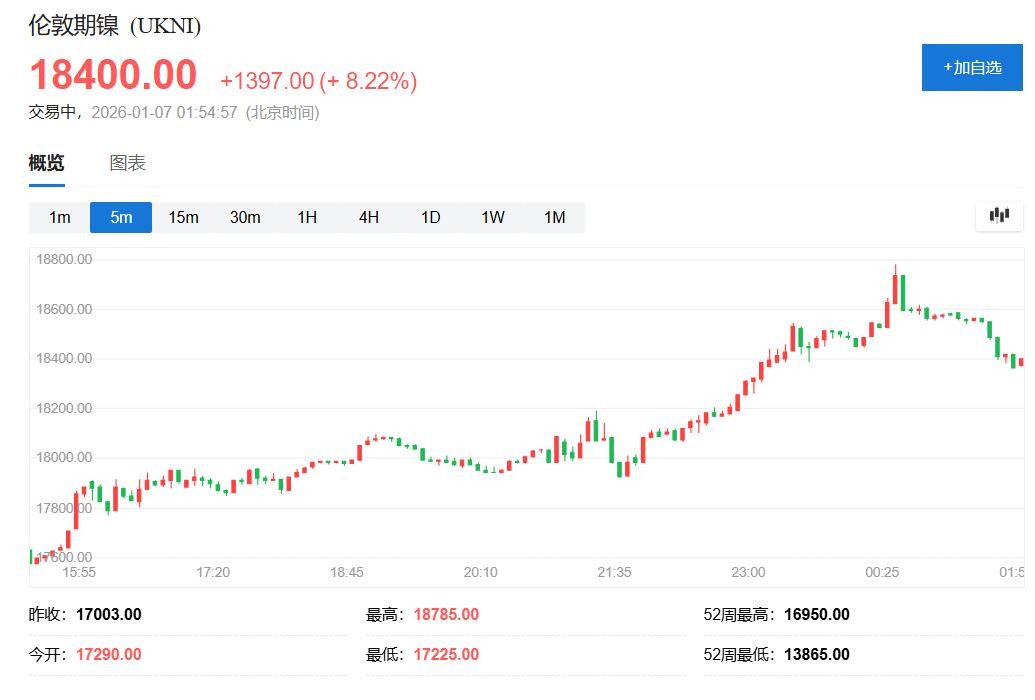
This is a dramatic turnaround. Previously, the nickel market had been troubled by excess capacity in Indonesia and lower-than-expected usage in electric vehicle batteries. This round of price increases also signifies a recovery in LME nickel contracts, which had seen a significant decline in trading volume following the historic short squeeze event in 2022.
Trading dynamics indicate that Chinese investors have played a key role in driving up nickel prices. LME futures prices jumped with high trading volumes during the Asian trading session and rose again after the night session opened on the Shanghai Futures Exchange. Although there is a severe oversupply in the nickel market, rising production risks in Indonesia, the world's largest supplier, have helped support market sentiment, coupled with a broad influx of investment funds into the domestic metal market in China.
London Copper Breaks Records: Inventories "Locked in the U.S."
LME three-month copper rose further on Tuesday, reaching a peak of $13,387.50 per ton during the session after breaking the $13,000 mark on Monday. This marked the highest intraday record for two consecutive days, with a daily increase of 3.1%, ultimately closing up nearly 1.9% at $13,238 per ton, marking the first close above $13,000. Copper prices have risen over 20% since the end of November 2025.
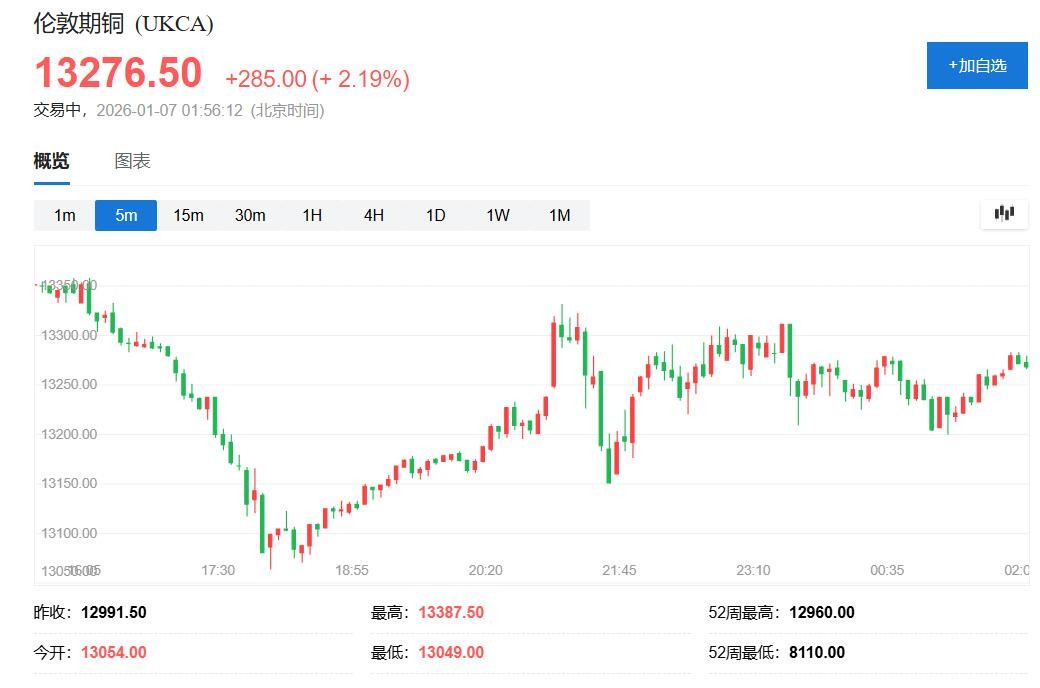
The massive inventory migration triggered by tariff expectations has become the core logic behind the surge in copper prices. Expectations that the Trump administration may impose tariffs on refined copper have prompted a large influx of inventory into the United States, leading to shortages in other parts of the world where miners are struggling to increase production.
Li Xuezhi, head of futures research at Chaos Tiancheng, commented, "Inventory used to serve as a buffer, but now it is locked in the U.S. So the buffer is gone, and everyone has to scramble for goods."
Although demand has slowed in recent months—especially in the largest consumer country, China—copper's continued flow to the U.S. has forced Chinese buyers to engage in bidding wars to secure supplies. The LMEX index, which tracks six major traded metals on the LME, has surged to its highest level since March 2022, and aluminum prices have also risen to their highest point in over three years. The initiation of a strike at Chile's Mantoverde copper mine has further exacerbated supply concerns.
Warren Patterson, head of commodity strategy at ING, stated, "Until the tariff issue is clarified, tariff risks will keep supply tight outside the U.S. and global prices high. The downside risk for copper prices is that if refined metals are exempted from tariffs again, the flow of funds to the U.S. may reverse, pushing inventory into the global market."
U.S. copper import data confirms this trend. In December of last year, U.S. copper imports surged to their highest level since July. Driven by rising copper prices, Freeport-McMoRan, a copper miner, rose over 4% in early trading on Tuesday, while Southern Copper, the largest publicly traded copper miner in the U.S. by market capitalization, also rose over 4%. BHP's U.S. stock briefly rose nearly 3%.
Silver Futures Soar: Chinese Retail Investors Trigger Self-Reinforcement
On Tuesday afternoon, U.S. stocks saw New York silver futures for March and spot silver both rise above $81, with daily increases exceeding 6%, approaching the intraday record set on December 29 last week. Silver futures recorded a 147% increase in 2025, marking the strongest annual performance in over 40 years since the 1970s.
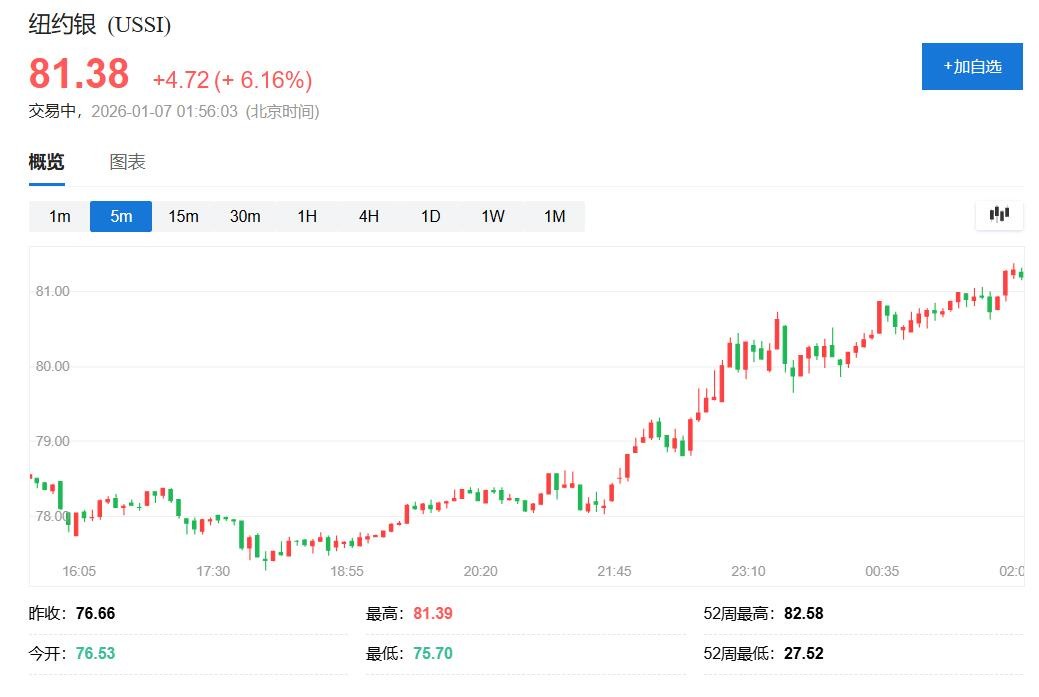
Chinese retail investors have played a key role in the latest surge in silver prices. Reports indicate that when silver broke the $80 mark in the last week of 2025, the queue in front of the trading counters at Shenzhen Shuibei Market, the largest gold and jewelry trading hub in the country, was even longer Jiemian News quoted local merchants commenting on the silver premium in the Shuibei market, stating that "it has never been this hot in recent years," and "in late December last year, it basically rose by one yuan a day, Shuibei went crazy, everyone was scrambling for silver."
There were also reports quoting precious metals dealer Fenny Zeng saying, "Even the aunties are coming," referring to the group of buyers that had previously propelled China to surpass India as the world's largest gold consumer in 2013.
This time, they are targeting silver. On one hand, gold prices have become too expensive. Although silver has also surged, its price remains cheap enough and volatile enough to be an attractive combination for those who feel they missed out on the gold market. The memory of the historic silver short squeeze event in the London market last October is still fresh, with reasons for silver bulls to remain optimistic, from declining Chinese inventories to potential U.S. import tariffs locking in a large supply in New York.
As the world's largest silver consumer, China's new demand for silver as a precious metal—rather than just an industrial raw material—has pushed the country's retail buyers to the forefront of the year-end frenzy.
In the few days of late December last year, the upward momentum became self-reinforcing: Chinese demand pushed up global spot prices, attracting more local buyers tempted by popular investment content on social media. The only pure silver fund in China even had to refuse new investors, fearing a high-risk surge in the premium of its underlying assets.
Gold Futures Rise: Geopolitical Risks and Rate Cut Expectations Resonating
New York gold futures broke above $4,500 during Tuesday's early trading session, rising over 1.1% intraday, while spot gold climbed above $4,490, gaining nearly 1% intraday, both hitting their highest levels since last Monday. Gold prices have cumulatively risen over 60% in 2025, marking the best annual performance since 1979.
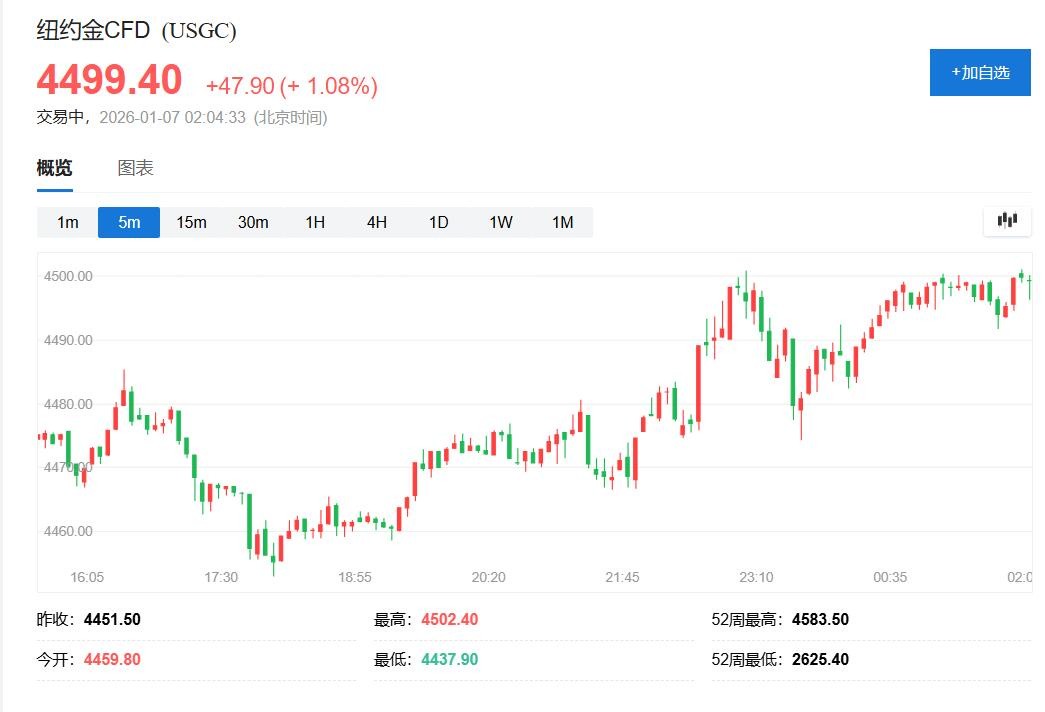
The geopolitical tensions triggered by the U.S. arrest of former Venezuelan President Maduro have boosted safe-haven demand. "Precious metals traders are currently seeing more risks than stock and bond traders," said Jim Wyckoff, senior analyst at Kitco Metals. "The U.S. raid on Venezuela over the weekend has sparked ongoing safe-haven demand for gold and silver."
Expectations of a Federal Reserve rate cut have also supported gold prices. Market participants are focusing on Friday's U.S. monthly employment report, expecting 60,000 new jobs in December, slightly lower than the previous value of 64,000. According to Refinitiv data, traders expect the Federal Reserve to cut rates twice this year. Richmond Fed President Tom Barkin stated that further rate adjustments must be "fine-tuned" to balance unemployment and inflation risks. Non-interest-bearing assets like gold tend to benefit in a low-interest-rate environment.
Carsten Fritsch of Commerzbank stated, "The U.S. military intervention in Venezuela over the weekend provided a tailwind, leading to increased safe-haven demand. Additionally, the disappointing U.S. manufacturing ISM index for December fell to a 14-month low." Morgan Stanley expects that benefiting from falling interest rates, changes in the Federal Reserve leadership, and strong purchases from central banks and funds, gold prices could soar to $4,800 per ounce in the fourth quarter of 2026.
Among precious metals, platinum and palladium outperformed silver and gold on Tuesday, with spot platinum and palladium rising more than 7% and 6% respectively during the session
