


AI Reshapes the Insurance Industry: Step One "Improve Operational Efficiency," Step Two "Enhance Underwriting Capability"

Morgan Stanley's report points out that AI will reshape the insurance industry in two phases: the first phase focuses on backend operational automation, which is expected to improve industry profitability by 1%-12% over the next five years; the second phase will delve into the core underwriting process, driving revenue growth through enhanced risk pricing capabilities. Despite facing initial investment and regulatory challenges, the efficiency dividends brought by AI are expected to lead to significant margin expansion in sub-sectors such as insurance brokerage, property insurance, and life insurance before 2030
Artificial intelligence is sparking a new "industrial revolution" in the insurance industry, a transformation that will fundamentally reshape the industry's operational efficiency and profitability through a multi-year adoption cycle.
Rather than being an instantaneous disruption, it is more of a phased evolution: The first phase focuses on improving the efficiency of back-end operations, which is seen as the "low-hanging fruit"; the second phase will delve deeper into the core, driving revenue growth and optimizing risk pricing through enhanced underwriting capabilities.
According to the Wind Trading Desk, on January 5th, Morgan Stanley's latest report pointed out that as AI capabilities evolve, the insurance industry is expected to achieve cost savings of 1% to 4% solely through efficiency improvements over the next five years, thereby driving profit growth of 1% to 12%. Although some early studies show that substantial investments in enterprise-level generative AI have yet to yield direct returns, this has not diminished the market's optimistic expectations for the application prospects in the insurance industry. The improvement of infrastructure will allow insurance companies to gradually unleash significant efficiency dividends in the coming years, especially in pain points where automated solutions are not yet available.
Changes in market sentiment have already begun to emerge in the third quarter earnings season of 2025. The frequency of mentions of AI in corporate earnings calls has significantly surged, indicating that management is ready to publicly discuss specific AI capabilities, implementation plans, and the substantial benefits they bring. This marks a shift in the industry from mere "concept hype" to "practical execution." Despite the substantial initial investments and increasingly complex regulatory environment, the logic of profit margin expansion driven by operational efficiency improvements has become the core focus of investors.
The impact of this technological wave on different segments will show a differentiated trend. In the short term, due to the investment in infrastructure construction and implementation costs, some companies may face slight pressure on their operating profit margins in 2026. However, looking ahead to 2030, the operational efficiencies brought by AI will translate into lasting competitive advantages, which will be difficult to completely erase even in a fiercely competitive pricing environment, indicating that the industry will enter a long cycle of profit margin improvement.
Two-Phase Evolution Path
The implementation of AI in the insurance industry will follow a clear "two-phase" path. The core of the first phase is the restructuring of back-end operations. By deploying AI in departments such as operations, customer service, finance, and human resources, insurance companies can quickly achieve process automation and efficiency improvements. The results of this phase are primarily reflected in the decrease in expense ratios, which can quickly translate to bottom-line profits.
The second phase is more profound, involving a qualitative change in underwriting capabilities. As technology matures, AI will not only be used for "cost-cutting" but also for "revenue generation"—that is, improving loss ratios and driving sales growth through optimized risk selection and enhanced pricing accuracy. Although current market analysis mainly focuses on the quantifiable benefits of the first phase, in the long run, the intelligence of the underwriting side will determine the core competitiveness of insurance companies in the future.
Quantitative Picture of Profit Margin Improvement
Different types of insurance institutions will gain varying degrees of benefits from the AI wave. According to Morgan Stanley's estimates, although insurance brokers are slightly lagging in initial deployment, they will be the biggest beneficiaries in the long run. Given that their business model is typically labor capital-intensive, the release of human efficiency through AI will have a tremendous leverage effect It is expected that by 2030, the operating profit margin of the brokerage industry will expand by approximately 400 basis points (bps), rising from about 29% to 33%.
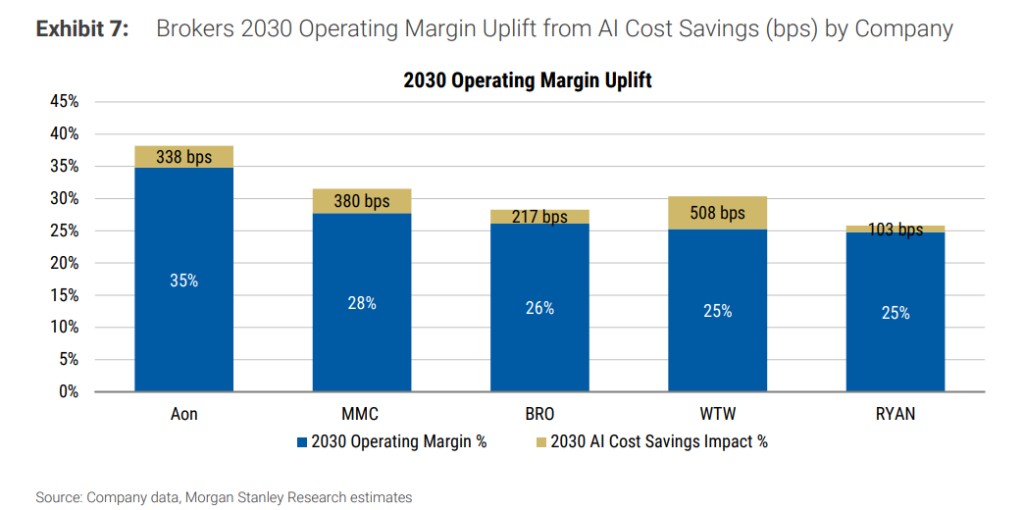
For property and casualty (P&C) insurers, the impact of AI is more reflected in the broad enhancement of productivity and the streamlining of workflows. It is expected that by 2030, the operating profit margin of this sector will increase by approximately 180 basis points. Notably, P&C insurers currently hold 89% of the AI patents in the insurance field, demonstrating their leading position in technological reserves.
The impact on life insurance companies is relatively mild, mainly focused on improving back-office operational efficiency. It is expected that by 2030, cost savings brought by AI will drive their operating profit margin up by approximately 220 basis points.
Back-office Operations as a High ROI Area
Although a study by the Massachusetts Institute of Technology pointed out that up to 95% of enterprises' generative AI investments yield zero return, in the insurance industry, back-office functions are becoming a high-return-on-investment (ROI) battleground that breaks this curse.
Currently, back-office applications, including supply chain procurement, finance, and human resource management, have a cloud deployment rate far lower than other software applications, with a significant amount of manual operations and legacy processes. This provides a huge improvement space for AI.
For example, applications such as automated generation of RFPs (Requests for Proposals), anomaly account detection, and resume screening can quickly translate into tangible cost reductions. Analysis from Morgan Stanley indicates that it is these "tedious" back-office functions that provide the most direct path for insurance companies to realize AI value.
Intelligent Reconstruction of Claims and Underwriting
At the business level, the automation of claims processing is another highlight of AI applications. Taking technology providers like CCC Intelligent Solutions and Mitchell International as examples, their AI-based image recognition and damage estimation solutions are significantly shortening the auto insurance claims cycle and reducing adjustment costs.
Through computer vision technology, simple auto insurance claims can achieve "straight-through processing" (STP), meaning that from reporting to payment, almost no human intervention is required. For complex cases, AI can assist adjusters in decision-making and even use 3D reconstruction technology to recreate accident scenes to identify fraud.
On the underwriting side, the application of AI is improving the speed and accuracy of quotes. Insurers that can respond to broker inquiries the fastest often have higher win rates, while the construction of dynamic pricing capabilities relies on the transition from big data to real-time data.
Evolution of the Regulatory Environment
As AI delves into the core operations of the insurance industry, the regulatory framework is also evolving in tandem. Currently, although there are no direct regulations at the federal level in the United States, the National Association of Insurance Commissioners (NAIC) has passed a model bulletin regarding the use of artificial intelligence systems by insurance companies. This bulletin emphasizes the importance of governance, risk management frameworks, documentation, and validation Regulators in states such as Colorado, California, and New York are developing or implementing more specific rules. This means that insurance companies' AI systems must have auditability, interpretability, and undergo rigorous bias testing.
Compliance is no longer an "option," but a "requirement." Companies that fail to establish a robust AI governance framework not only face the risk of regulatory enforcement but may also suffer reputational damage due to model defects. For the industry, while the clarification of regulations increases short-term compliance costs, it also sets a clear track for responsible AI applications
