


The ChatGPT moment of physical AI! NVIDIA's "self-driven" autonomous vehicles are coming and will hit the roads in the U.S. in the first quarter

NVIDIA announced the open-source of its first inference VLA (Vision-Language-Action) model Alpamayo 1. This model aims to create vehicles that can "think" and solve problems in unexpected situations, utilizing a 10 billion parameter architecture to generate trajectories and reasoning processes using video input. Jensen Huang stated that the first vehicles equipped with NVIDIA technology will hit the roads in the U.S. in the first quarter, in Europe in the second quarter, and in Asia in the second half of the year. NVIDIA also released several open-source models, data, and tools, such as the NVIDIA Nemotron family for agent AI, the Cosmos platform for physical AI, NVIDIA Isaac GR00T for robotics, and NVIDIA Clara for biomedical applications. In the update
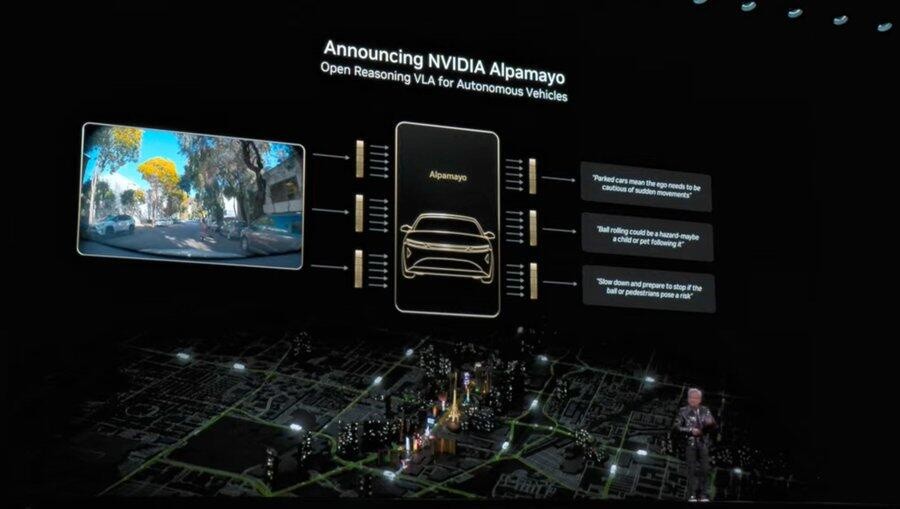
NVIDIA has taken a key step in the field of autonomous driving by announcing the open-source release of its first inference VLA (Vision-Language-Action) model, Alpamayo 1. This initiative aims to accelerate the development of safe autonomous driving technology. The model processes complex driving scenarios using human-like reasoning, providing new pathways to address the long-tail problems of autonomous driving.
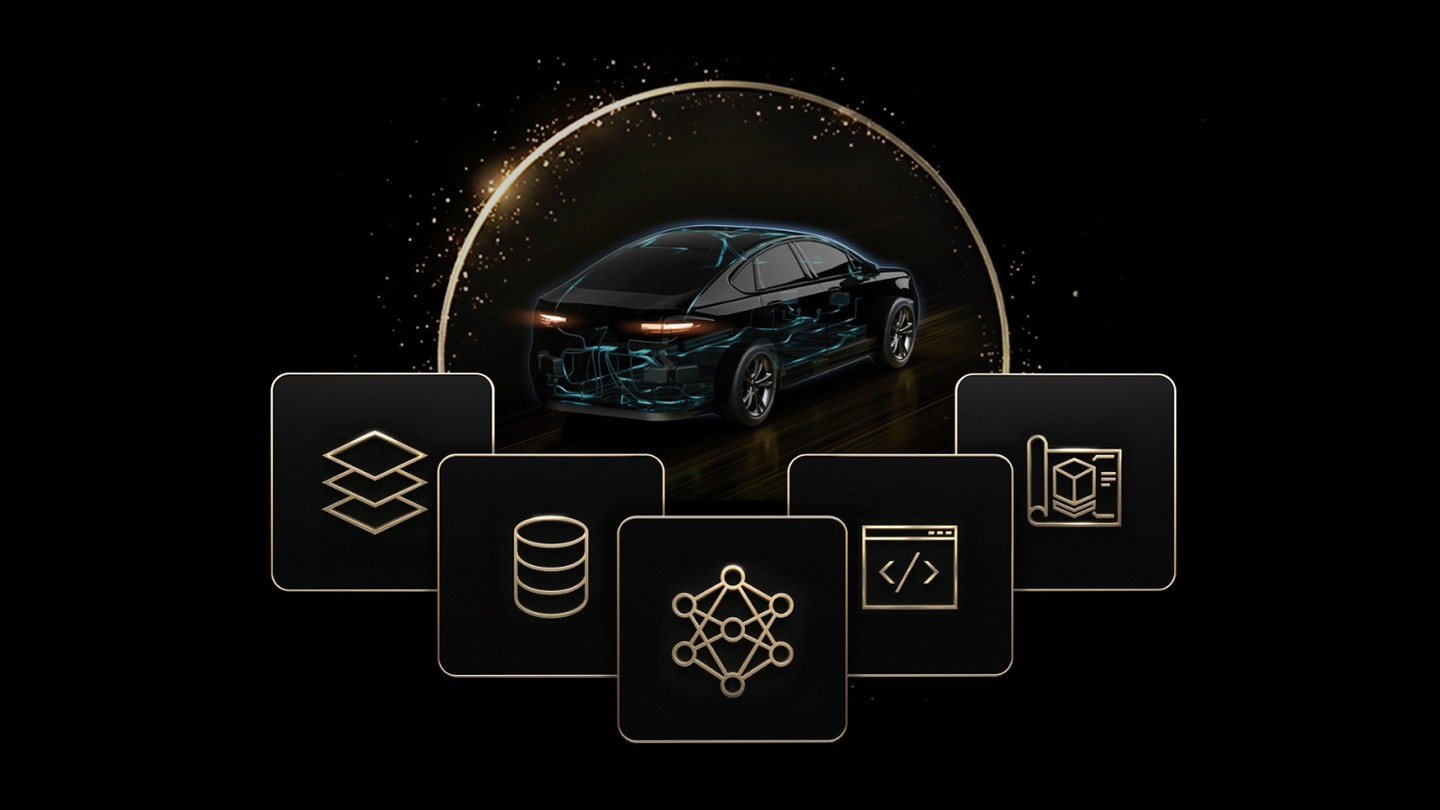
On January 5th, Eastern Time, NVIDIA CEO Jensen Huang unveiled the Alpamayo platform at the CES exhibition in Las Vegas, enabling vehicles to "reason" in the real world. Jensen Huang stated that the first vehicles equipped with NVIDIA technology will hit the roads in the United States in the first quarter, in Europe in the second quarter, and in Asia in the second half of the year.
NVIDIA has made the Alpamayo model available for free, allowing potential users to retrain the model themselves. The model is designed to create vehicles that can "think" of solutions in unexpected situations, such as traffic signal failures. The onboard computer will analyze inputs from cameras and other sensors, break them down into steps, and propose solutions.
This open-source initiative has received widespread support from the industry. Leading mobility companies and research institutions, including Jaguar Land Rover (JLR), Lucid, Uber, and the Berkeley DeepDrive (BDD) deep learning autonomous driving industry alliance at the University of California, Berkeley, have expressed their intention to utilize Alpamayo to develop a reasoning-based autonomous driving technology stack, promoting the deployment of Level 4 autonomous driving.
Additionally, NVIDIA has launched artificial intelligence models and other technologies for robotics. Jensen Huang stated during the event that NVIDIA is collaborating with Siemens to apply artificial intelligence to more areas of the physical world.
Release of the First Open-Source Inference VLA Model
The Alpamayo family released by NVIDIA integrates three foundational pillars: an open-source model, a simulation framework, and datasets, creating a complete open ecosystem for any automotive developer or research team to use.
Alpamayo 1 is the industry's first reasoning chain inference VLA model designed for the autonomous driving research community and is now available on the Hugging Face platform. The model features a 10 billion parameter architecture, using video inputs to generate trajectories and reasoning paths, showcasing the logic behind each decision. Developers can adapt Alpamayo 1 into smaller runtime models for vehicle development or use it as a foundation for autonomous driving development tools, such as reasoning-based evaluators and automatic labeling systems.

"The era of physical AI's ChatGPT has arrived—machines are beginning to understand, reason, and act in the real world. Autonomous taxis are among the first beneficiaries. Alpamayo brings reasoning capabilities to self-driving cars, enabling them to think through rare scenarios, drive safely in complex environments, and explain their driving decisions—this is the foundation for safe and scalable autonomous driving."
NVIDIA emphasized that the Alpamayo model does not run directly in the vehicle but serves as a large-scale teacher model for developers to fine-tune and integrate into their complete autonomous driving technology stack. Future models in this family will have larger parameter scales, more detailed reasoning capabilities, greater input-output flexibility, and commercial use options.
Analysis of Reasoning VLA Technology Principles
Reasoning VLA is a unified AI model that integrates visual perception, language understanding, and action generation with step-by-step reasoning.
These models incorporate explicit AI reasoning capabilities, built on traditional visual-language-action models. AI reasoning is the ability of AI to incrementally solve complex problems and generate traces of reasoning similar to human thought processes. These systems are pre-trained on a range of internet-scale tasks, including language generation and visual connections, to develop general knowledge and perceptual foundations.
Unlike standard VLA models that directly map visual inputs to actions, reasoning VLA models break complex tasks into manageable subproblems and clarify their reasoning processes in an interpretable form. This enables the model to solve problems or perform tasks more accurately while providing a degree of reflection on the operations being performed.
Building a reasoning VLA model requires three fundamental AI capabilities: visual perception, language understanding, and action and decision-making. Visual perception processes real-time data from perception sensors such as cameras, millimeter-wave radar, or LiDAR; language understanding interprets commands, contextual prompts, and dialogue inputs through natural language processing; action and decision-making use fused sensory and language information to plan, select, and safely execute tasks while generating interpretable reasoning traces.
In autonomous driving scenarios, reasoning VLA can perform step-by-step reasoning about traffic conditions. For example, as it approaches an intersection, the system might reason: "I see a stop sign, there are vehicles coming from the left, and pedestrians are crossing the street. I should slow down, come to a complete stop, wait for the pedestrians to cross the crosswalk, and then proceed when it is safe."
Complete Open Ecosystem Supports Development
In addition to the Alpamayo 1 model, NVIDIA has also released supporting simulation tools and datasets to build a complete development ecosystem.
AlpaSim is a fully open-source end-to-end simulation framework for high-fidelity autonomous driving development, now available on the GitHub platform. It provides realistic sensor modeling, configurable traffic dynamics, and scalable closed-loop testing environments for rapid validation and strategy optimization.
NVIDIA also offers the most diverse large-scale open dataset for autonomous driving, containing over 1,700 hours of driving data, covering the widest range of geographic locations and conditions, including rare and complex real-world edge cases, which are crucial for advancing reasoning architecturesThese datasets are available on the Hugging Face platform.
These tools together create a self-reinforcing development loop for inference-based autonomous driving technology stacks. Developers can leverage these resources to fine-tune models on proprietary fleet data, integrate them into the NVIDIA DRIVE Hyperion architecture built on NVIDIA DRIVE AGX Thor accelerated computing, and validate performance through simulation before commercial deployment.
Industry Leaders Express Support
According to NVIDIA, several leading companies in the mobility sector have shown strong interest in Alpamayo.
Kai Stepper, Vice President of Advanced Driver Assistance Systems and Autonomous Driving at Lucid Motors, stated: "The shift towards physical AI highlights the growing demand for AI systems to reason about real-world behaviors, not just process data. Advanced simulation environments, rich datasets, and reasoning models are key elements of this evolution."
Thomas Müller, Executive Director of Product Engineering at Jaguar Land Rover, remarked: "Open and transparent AI development is crucial for responsibly advancing automated mobility. By open-sourcing models like Alpamayo, NVIDIA is helping to accelerate innovation across the entire autonomous driving ecosystem, providing developers and researchers with new tools to safely tackle complex real-world scenarios."
Sarfraz Maredia, Head of Global Automated Mobility and Delivery at Uber, said: "Handling long-tail and unpredictable driving scenarios is one of the defining challenges of autonomous driving. Alpamayo creates exciting new opportunities for the industry to accelerate physical AI, enhance transparency, and increase safe Level 4 deployments."
Wei Zhan, Co-Director of DeepDrive at the University of California, Berkeley, stated: "The launch of the Alpamayo suite represents a significant leap for the research community. NVIDIA's decision to make this technology public is transformative, as its accessibility and capabilities will allow us to train at an unprecedented scale—providing us with the flexibility and resources needed to bring autonomous driving into the mainstream."
Cross-Industry AI Models Fully Opened
This Monday, NVIDIA also released several new open-source models, data, and tools to drive AI development across industries.
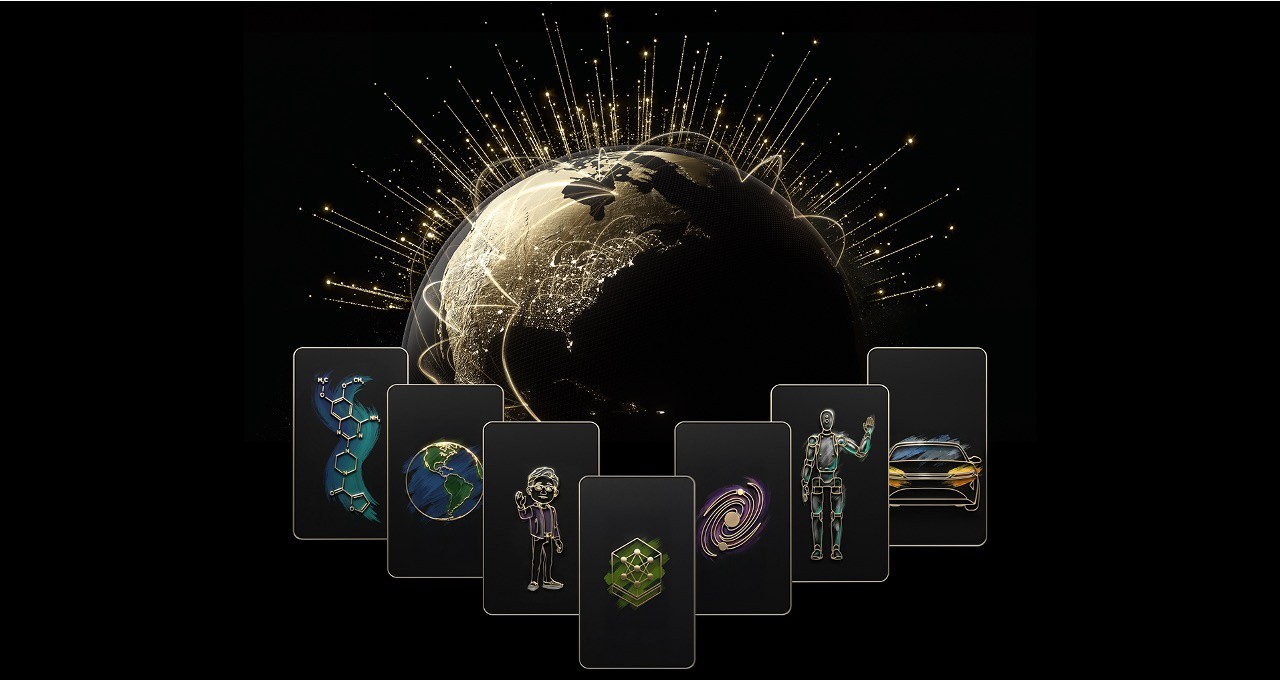
These models include the NVIDIA Nemotron family for agent AI, the NVIDIA Cosmos platform for physical AI, the NVIDIA Isaac GR00T for robotics, and the NVIDIA Clara for biomedicine. NVIDIA also provides an open-source training framework and one of the largest open multimodal datasets globally, including 100 trillion language training tokens, 500,000 robot trajectories, 455,000 protein structures, and 100TB of vehicle sensor dataNVIDIA's agent-based AI foundational model Nemotron has released new models for speech, multimodal retrieval-augmented generation (RAG), and security-related applications. Nemotron Speech includes industry-leading open-source models that provide real-time, low-latency speech recognition for live captioning and speech AI applications. Nemotron RAG features new embedding and re-ranking visual language models that offer highly accurate multilingual and multimodal data insights.
In the field of physical AI and robotics, NVIDIA has launched the Cosmos open-world foundational model, which brings human-like reasoning and world generation capabilities to accelerate the development and validation of physical AI. Isaac GR00T N1.6 is an open reasoning VLA model designed for humanoid robots, achieving full-body control and utilizing NVIDIA's Cosmos Reason for improved reasoning and contextual understanding.
NVIDIA states that tech industry leaders such as Bosch, CodeRabbit, CrowdStrike, Cohesity, Fortinet, Franka Robotics, Humanoid, Palantir, Salesforce, ServiceNow, Hitachi, and Uber are adopting and developing based on NVIDIA's open-source model technology.
NVIDIA's open-source models, data, and frameworks are now available on GitHub and Hugging Face platforms and can be accessed through a range of cloud, inference, and AI infrastructure platforms, as well as build.nvidia.com. Many of these models are also offered in the form of NVIDIA NIM microservices, enabling secure and scalable deployment across any NVIDIA accelerated infrastructure from edge to cloud
