


What is the gamble behind the billion-dollar acquisition? Key interpretations of Manus's pivot towards Meta

On December 30th, Meta announced the acquisition of the general autonomous AI company Manus for several billion dollars. This deal shocked the tech industry, mainly because Manus was recently seeking financing with a valuation of $2 billion, only to be swiftly acquired. The industry generally considers this price reasonable, as Manus has strong product capabilities and the founding team has made several successful choices. After the transaction, Manus will maintain relatively independent operations, with founder Xiao Hong serving as Vice President of Meta, responsible for global business. This acquisition is seen as a significant event in the tech industry and may have far-reaching implications
On December 30th, Beijing time, Meta announced the completion of its acquisition of the general-purpose AI intelligent body company Manus (Butterfly Effect). The transaction amount is approximately several billion dollars.
The comments from the domestic tech circle regarding this transaction are predominantly summed up in two words: "shocking."
After discussions with several investors and creators in the Agent field, Tencent Technology found that the shock mainly concentrated on the following points:
- Manus was recently reported to be seeking the next round of financing with a valuation of $2 billion, and it was unexpected that it was acquired by Meta so quickly;
- The description of "several billion dollars" leaves a lot of room for imagination; if it is above $4 billion, Meta has truly shown great sincerity (anxiety);
- Why was a startup founded in China ultimately acquired by Meta?
However, there are also several points of consensus:
- This price is very good; the founding team of Manus made several key choices that were excellent, and we are happy for Manus;
- After all, general-purpose agents are on the "mainstream" path of large models, and being acquired by a big company is their destined outcome;
- Manus has strong product capabilities and is well-regarded and popular in Silicon Valley, which is also a solid foundation for its valuation;
- This is the best outcome and the best timing.
At the end of 2025, the union of MM (Manus-Meta) may, like the name of Manus's company—"Butterfly Effect"—cause ripples in the tech circle.
01 How much is Manus worth?
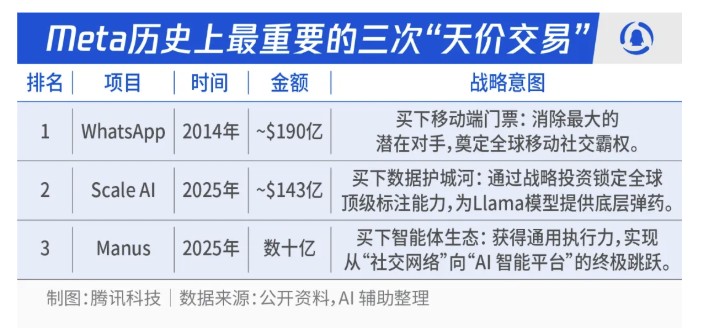
According to official announcements and public information from Meta and Manus, the transaction amount reaches several billion dollars, making it the third-largest acquisition since Meta's establishment, second only to the acquisition of WhatsApp and the previous strategic investment in Scale AI.
According to disclosed information from both parties, after the transaction is completed, Manus will continue to operate relatively independently, with the company's founder and CEO, Xiao Hong, serving as Meta's Vice President, responsible for leading Meta's global business in general-purpose AI agents.
Several individuals close to the transaction revealed that the acquisition negotiations between Meta and Manus progressed very quickly, taking only a little over ten days from initial contact to final signing.
How much is Manus really worth? Based on a comprehensive analysis of various information, the acquisition price may fall within the following range:
Most likely range: $2-3 billion
- Valuation premium multiple: A 25%-50% premium on the financing valuation ($2 billion)
- Revenue multiple: $2-3 billion corresponds to an ARR multiple of 16-24 times, in line with the valuation level of high-growth SaaS companies
- Strategic value: Considering Manus's technological leadership, paid user base, and rapid growth potential
- Transaction speed: The negotiations were completed in just over ten days, indicating that both parties quickly reached a consensus on the price range From the perspective of the lower valuation limit, the price of this transaction is around $2 billion, as Manus was recently reported to be preparing for a new round of financing at that valuation before Meta intervened. Moreover, foreign media generally believe that based on the previous round's valuation of $500 million, $2 billion is a logical premium starting point.
From the upper limit perspective, the acquisition amount should not exceed $5 billion, mainly because Manus's annual recurring revenue (ARR) of $125 million is limited and difficult to support a higher valuation multiple. As Meta's third-largest acquisition since its establishment, the price is significantly lower than the first two—Scale AI (approximately $14.3 billion to $15 billion) and WhatsApp (approximately $19 billion).
An investor focused on early-stage venture capital told Tencent Technology that based on the current $125 million ARR, benchmarking against current Silicon Valley startups, a valuation of $2 billion to $3 billion is reasonable, while a valuation of $4 billion to $5 billion would be considered high.
02 Meta: Is Manus Indispensable?
Meta swiftly and decisively acquired Manus at a not insignificant price, with public information indicating that "negotiations were completed in just over ten days."
So, what exactly does Meta value in Manus?
Meta officially positions Manus as a key "execution layer" component in its AI strategy, with the goal not of launching a single product, but of gradually integrating this intelligent system with end-to-end execution capabilities into its vast social and enterprise service platform.
From a business perspective, Manus achieved over $125 million in annualized revenue (ARR) within just 8 months of its launch, demonstrating an extremely rare pace of commercialization.
Its technical solution has also been validated under high loads in the real world: the system has processed over 147 trillion tokens and supports the operation of more than 80 million virtual computers. This engineering resilience means Manus is no longer a demonstration model stuck in the laboratory stage, but has the capability to provide continuous and reliable delivery services to global users.
On a deeper level, it also reflects Meta's transformation anxiety.
An entrepreneur in the Agent field in Silicon Valley told Tencent Technology: "To understand this in a broader context, the current AI era can be likened to the early days of mobile internet. Meta has once again deployed the strategy it used to acquire Instagram and WhatsApp: during a critical window of life and death, 'buying' is definitely more efficient than 'doing it ourselves and then operating it.'
Meta's current situation is actually quite urgent; the original main storyline Llama has shown signs of fatigue and cannot win against competitors. If it cannot produce something like Manus that could potentially break the deadlock, Wall Street will classify it as an 'old company' from the 'previous generation' in no time. Therefore, the cost-effectiveness of this transaction is not important at this moment; rather than letting money sit in the account as a fluctuating number in the secondary market, it is better to quickly convert it into assets like Manus. This is the key for Meta to survive and turn the tide in the AI race ”
So, besides Manus, does Meta have any better options? "Perplexity was once an option, but at that time, Meta's entire strategic focus was on Llama. Now, with a mature product and a user base, Manus may be the best choice," a technology sector investor told Tencent Technology.
03 Manus, the best outcome?
Meta needs Manus, but is being acquired by Meta the best outcome for Manus? On this question, several investors and AI entrepreneurs have surprisingly consistent views.
"This is the best outcome, and it's the best timing."
"Manus co-founder Xiao Hong has a very strong product intuition. Moreover, during Manus's development, several key decisions were made very decisively and accurately," an investor close to Manus told Tencent Technology.
Some key decisions made by Manus include:
-
Although the company (Butterfly Effect) was established as early as 2022, the real turning point came in October 2024 when the team decided to develop the first general Agent product, Manus, achieving a growth miracle of over $100 million ARR within 8 months.
-
Among these, Manus made an extremely difficult decision: even though the founding team and most of the R&D force are located in China (Beijing, Wuhan), they chose to launch the product overseas first and used top models like Anthropic that are inaccessible domestically as the underlying support. Despite facing immense public pressure, this decision led to an explosion in the global market.
-
After securing $75 million in funding from Benchmark, Manus quickly moved its headquarters to Singapore, clearing the biggest legal and capital obstacles for later acquisition by a U.S. giant like Meta.
-
This time, they unhesitatingly accepted the olive branch extended by Meta and did not insist on "having to go public independently," which was another key choice.
Although Manus's product is powerful, the general Agent still operates in the main channel of large models.
Silicon Valley entrepreneur How told Tencent Technology: "I evaluated Manus early on; the technical barrier is not strong, but the product iteration is very fast. Xiao Hong has excellent product intuition. Being acquired by a big company is the best outcome and a win-win situation, but it also exposes the bottleneck of AI startups: Profit Margin."
For general Agent products like Manus, each task execution requires calling expensive large models and cloud virtual machines. Although its ARR has surpassed $125 million, after deducting payments to cloud vendors (like AWS, NVIDIA) and bills from underlying model companies, the remaining "net profit" may be much thinner than that of traditional software companies In this business model, the survival space and pricing power of startups will be extremely compressed. When Manus had only 10,000 users, the losses were manageable, but as the user base continues to grow, "Profit Margin" becomes a more difficult bottleneck to overcome.
Manus's subscription price is basically on par with the subscription prices of global SOTA large models. If it cannot clearly demonstrate how it is stronger than "general large models," companies with deeper funding and larger user bases will obviously have stronger competitiveness.
"Now is the best time. If we don't sell now, we might not be able to sell later, or we won't be able to sell at such a good price." In terms of timing and price, both Manus and its investors have achieved substantial returns.
For Manus: achieving a valuation leap from $14 million to $2-3 billion in less than 3 years; for investors: obtaining a considerable return of 5-12 times. For example, ZhenFund, as a seed and angel round investor, participated in 4 rounds of financing and is expected to achieve an overall return of over 10 times, validating the accuracy of early judgments.
However, Manus's acquisition has once again sparked controversy: why was Manus sold to Meta instead of a Chinese company?
One viewpoint is that domestic investors hesitated and did not understand the underlying logic of Manus; another viewpoint is that the valuation was too high, the cost-performance ratio was not good, or there was simply no money to invest.
"At that time, apart from Sequoia, it can be said that all investors in China rejected Xiao Hong," a person close to Manus told Tencent Technology. "After Manus took shape, it became Benchmark; the valuation given by domestic capital was not high enough."
Benchmark Capital is one of the most legendary venture capital firms in Silicon Valley. In April 2025, Benchmark led Manus's Series B financing, amounting to $75 million. If Meta acquires it for $2.5 billion, Benchmark will have achieved about 5 times the return in just 8 months.
Regarding today's outcome, the aforementioned insider said: "It's good; investors have returns, and entrepreneurs have returns."
As for the future, whether Manus's founding team will continue to stay at Meta and whether Xiao Hong will really remain as Meta's Vice President, opinions in the industry vary.
Some believe that Meta is also buying the Manus team, and they won't leave in the short term; another viewpoint is that for the Manus team, this round of entrepreneurship has perfectly concluded. Xiao Hong as Meta's VP is merely a symbolic acquisition condition.
Some investors have given a more macro evaluation of this event: "This acquisition is seen as a milestone in the AI Agent industry and a symbol of the global competitive spirit of a new generation of Chinese entrepreneurs." Risk Warning and Disclaimer
The market has risks, and investment should be cautious. This article does not constitute personal investment advice and does not take into account the specific investment goals, financial situation, or needs of individual users. Users should consider whether any opinions, views, or conclusions in this article align with their specific circumstances. Investment based on this is at one's own risk
