


泡泡玛特热潮遇冷:黄牛停止囤货,Labubu 溢价神话正在破灭

The POP MART craze is facing severe challenges, as the premium myth of its iconic IP "Labubu" has first collapsed in the secondary market: scalpers have stopped hoarding due to the disappearance of resale profits, and the second-hand prices of some series have fallen below the official retail price. This phenomenon has directly triggered a sharp decline in stock prices and forced the market to reassess the sustainability of its business model—whether the growth narrative driven by a single hit IP has reached its ceiling
The once hot "Labubu economy" is facing severe challenges. With a significant decline in the secondary market's premium ability, the halo of POP MART as a darling of the capital market is fading. Investors are beginning to reassess whether this Chinese toy manufacturer can maintain its high growth myth and whether its core IP is merely a fleeting trend.
According to Bloomberg, due to media reports revealing that demand from resellers (scalpers) for Labubu toys has weakened, POP MART's stock price fell by as much as 6.2% on Tuesday, marking the largest drop in three weeks and making it one of the worst-performing stocks in the MSCI Asia-Pacific Index.
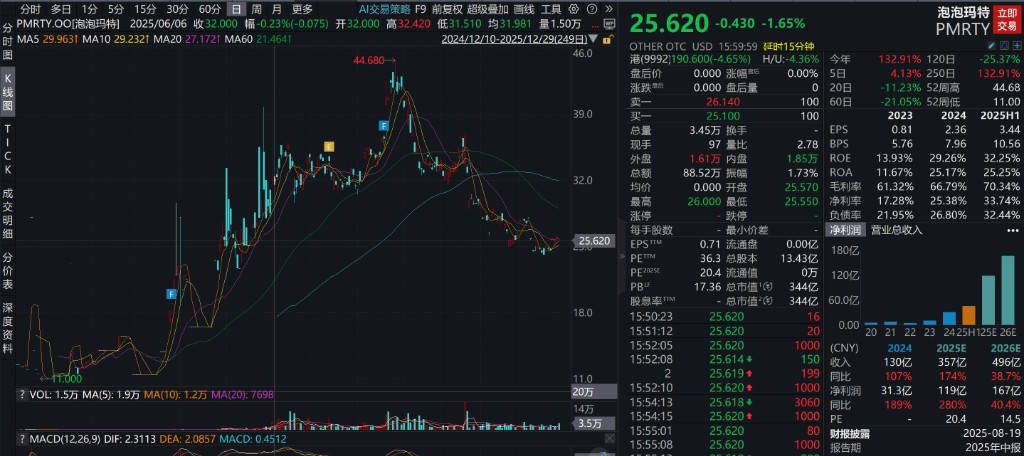
The direct trigger for the sell-off was reports indicating that the severe price fluctuations in China's secondary market have signaled weak demand, leading some scalpers to suspend their stockpiling activities.
This dynamic has severely impacted market confidence. Since peaking in August this year, POP MART's stock price has cumulatively fallen by about 44%, with a market value evaporating by over $25 billion. Previously, buoyed by the popularity of Labubu dolls, the company had staged one of the most dramatic rebounds in the recent market. Although its stock price has more than doubled this year, recent data indicates that both domestic resale prices and overseas holiday sales have shown signs of underperformance.
Kenny Ng, an international strategist at Everbright Securities, pointed out that investors' concerns about a potential cooling of product popularity linger. Reports of weakening demand often have a heavy impact on stock prices. Currently, the core concern in the market is whether the toothy monster that supported POP MART's 3200% rebound since the low point in 2022 is a long-term IP that can withstand the test of time or merely a fast-fashion product with an expiration date.
Disappearance of Secondary Market Premiums and Exit of Scalpers
As an early warning indicator of the collectibles cycle, the price fluctuations in the secondary market are the most sensitive.
Data from the toy resale platform Qianshao shows that the average price of the complete mini Labubu set or the "Sit Tight" series has fallen below the official retail price.
On the U.S. resale website StockX, although Labubu still dominates the collectibles market, the premium myth is collapsing. The "Sit Tight" series, which was once speculated to nearly $400, is currently priced at about $110, far below its retail price of $168; the premium on some rare versions has also significantly shrunk from the highs in June.
This price inversion has directly led to the exit of scalpers, further affecting investor sentiment. Jeff Zhang, an analyst at Morningstar, stated that some investors may be rotating out of China's "new consumption" stocks to lock in profits, with other stocks in the same sector, such as Laoputang and Mixue Bingcheng, also experiencing varying degrees of decline on Tuesday.
Growth Slowdown and Concerns over "Doudou Baby"
In addition to the cooling of the resale market, POP MART's expansion pace in overseas markets has also come under scrutiny. According to data analysis company YipitData, as of the quarter ending December 6, POP MART's revenue growth in North America has slowed to 424%, halving compared to the growth rate for the three months ending in September Despite the company's aggressive marketing efforts in the U.S., including the Macy's Thanksgiving Day Parade and the Empire State Building exhibition, Google search interest has continued to cool since peaking in the summer.
Disappointing "Black Friday" performance in the U.S., coupled with a cooling resale demand, has reminded the market of the bursting of the "Beanie Babies" bubble in the 1990s. This also challenges the narrative of whether POP MART can become China's version of Walt Disney or Sanrio, the parent company of Hello Kitty.
According to S&P Global, short bets against the stock have doubled since November, reaching the highest level since August 2023.
Richard Lin, Chief Consumer Analyst at Ping An International, stated, "The market is very concerned about POP MART's short-term data. The biggest question is, if it cannot maintain a very high year-on-year growth rate by the end of the year, will it still be able to achieve growth next year under the high base effect?"
Valuation Discrepancies and Diversification Attempts
In the face of market skepticism, some institutional investors have chosen to wait and see. Kevin Net, Head of Asian Equities at Financiere de L’Echiquier, noted that market sentiment has clearly turned negative. Although valuations were not considered expensive in late September, there are many questions about future earnings per share, leading him to wait for a better re-entry opportunity.
Daisy Li, a fund manager at EFG Asset Management, also admitted that since Labubu is a non-essential consumer product, it is inherently difficult to model, making it hard to establish a strong investment conviction.
However, sell-side analysts generally remain optimistic, with an average 12-month target price about 84% higher than the latest closing price. Morgan Stanley analyst Dustin Wei and others pointed out in a report that while short-term profit-taking and pullbacks are normal, pushing the stock price down to bottom valuations seems "too preemptive" and unreasonable. They believe the market is overlooking the long-term expansion of POP MART's recurring customer base.
To address the risk of reliance on a single IP, POP MART is betting on other IPs such as Crybaby, Twinkle Twinkle, and Hirono, and is actively venturing into the entertainment industry, including opening a theme park in Beijing, reaching a film development agreement with Sony Pictures, and launching the jewelry brand POPOP.
However, Xiadong Bao, a fund manager at Edmond de Rothschild Asset Management, warned that the biggest concern currently is whether the momentum of Labubu and its leading IP is waning. If Labubu's sales decline, other characters "may not be sufficient to compensate and maintain the strong momentum already factored into the previous stock price."
