


The interest rate cut cycle impacts, U.S. private credit listed funds face their worst performance in five years

Due to multiple blows such as expectations of interest rate cuts, narrowing interest rate spreads, and rising credit pressures, U.S. BDCs are expected to decline by about 6.6% in 2025, marking the worst performance since 2020. The market is undergoing a deep adjustment: the era of double-digit returns has ended, investor redemption pressures have surged, and short interest has significantly increased. As a result, the industry is turning to new structures such as interval funds and seeking breakthroughs in areas like asset-backed financing, while private credit enters the second half of testing managers' risk control capabilities
With the impact of the interest rate cut cycle and changes in the market environment, U.S. listed business development companies (BDCs) are facing their worst annual performance relative to the S&P 500 index since 2020, prompting investors to reassess the prospects of such assets in the $1.7 trillion private credit market.
According to data compiled by Bloomberg, as of December 24, the Cliffwater BDC Index, which tracks 41 direct lending investment tools, has fallen about 6.6% this year, contrasting sharply with the S&P 500 index, which rose about 18.1% during the same period. The BDC index recorded gains of 25.4% and 14.1% in 2023 and 2024, respectively.
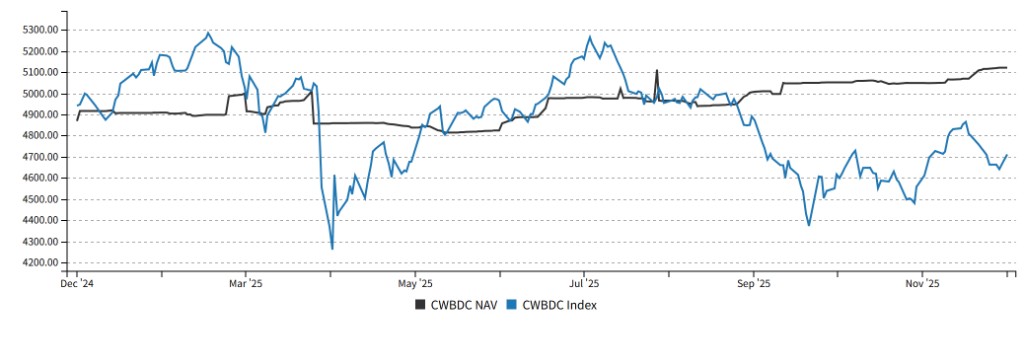
Against the backdrop of the Federal Reserve preparing to continue cutting interest rates next year, coupled with a lack of private credit transactions leading to narrower loan profit margins, BDCs have suffered multiple blows from interest rate cut expectations, market shocks, and rising pressure signals.
The shift in market sentiment has directly affected investor confidence and capital flows. Some large funds are facing increased pressure from redemption requests, forcing the industry to reassess return expectations, with the traditional double-digit return era potentially coming to an end, replaced by mid-to-high single-digit return levels.
Underperformance Raises Investor Doubts
This year, BDCs have significantly underperformed the market, raising widespread doubts about this asset class. Matt Malone, head of investment management at Opto Investments, stated that clients are skeptical about whether large and widely distributed investment tools can maintain past return levels.
Over the past year, the private credit market has continued to expand and mature, beginning to take on blue-chip artificial intelligence infrastructure projects and more investment-grade debt. This shift has led investors to reconsider whether this is still the best risk-adjusted way to invest in private credit for clients. Despite companies like Blue Owl Capital Inc., Ares Management Corp., and Blackstone Inc. attempting to reassure investors for months that their portfolios remain healthy and that stock prices have been unfairly punished due to widespread credit market shocks, this has not completely alleviated market concerns.
Although data from Moody's indicates that financing for non-traded private credit funds has remained stable over the past year—such as Blackstone's non-traded fund BCRED raising $2.8 billion in new net equity in the third quarter and Blue Owl's OCIC attracting $1.9 billion—requests for investor withdrawals are increasing for some large institutions.
In November, redemption requests for Blue Owl's BDC product OBDC II exceeded 5% of the fund's net asset value. Meanwhile, the Blackstone Private Credit Fund expects its redemption requests for the fourth quarter to reach 4.5% of the fund's net asset value as of September 30 In addition, the decline in BDC stock prices has hindered some managers' strategic deployments. Blue Owl attempted to merge its smaller private equity fund, Blue Owl Capital Corp. II, into its larger publicly traded OBDC, which was trading at a discount of about 20% to its net asset value at the time. However, due to the market's strict scrutiny of potential losses that investors might face, the company withdrew this plan just a few days later.
Narrowing Spreads Pressure Return Expectations
Looking ahead, as the Federal Reserve continues to cut interest rates next year, private credit managers must work hard to convince investors that their BDCs are still worth investing in. According to Wells Fargo & Co., the average spread on private credit transactions has narrowed from 650 basis points in the first quarter of 2023 to less than 500 basis points (over the benchmark rate). Tony Yoseloff, managing partner and chief investment officer at Davidson Kempner, candidly stated:
"The issue is that direct corporate lending has long been touted as an asset class with double-digit returns, but that is no longer the case today."
He noted that as returns decline, this asset class will increasingly resemble a mid-to-high single-digit return product.
Given the lukewarm response from investors towards BDCs, private credit managers have begun to pivot towards launching perpetual private instruments, such as interval funds. These funds allow for continuous financing without the hassle of stock price volatility.
Christopher P. Healey, a partner at Davis Polk & Wardwell, believes that interval funds are seen as a "second-generation product" following the launch of BDCs, as they are more investor-friendly and offer better liquidity. According to regulations, interval funds must provide investors with periodic redemption services.
Moreover, this packaging format can accommodate products that typical BDCs cannot cover, such as investment-grade private credit and asset-backed financing, which is also an area that managers are trying to expand into. Bill Bielefeld, co-head of Dechert's permanent capital business, stated that as there is a broader focus on the private credit space, investors not only want access to direct loans but also to asset-backed financing products that are more suitable for the interval fund structure rather than BDCs.
Short Seller Gathering and Credit Pressure Signals
The weak performance of the BDC market has attracted the attention of short sellers. According to research firm S3 Partners, the total short interest in 47 publicly traded BDCs this year amounts to approximately $1.83 billion, with over $500 million in new shorts, a 38% increase from a year ago. Traders have realized a profit of approximately $132.7 million based on market value, an increase of about 7% year-on-year.
Short sellers are focusing on the increasingly evident pressure signals in the private credit market. According to Raymond James, the physical payment-in-kind (PIK) debt income, which signals a borrower's inability to pay cash, has been on the rise in BDCs, reaching 7.9% in the third quarter. During the same period, 3.6% of investments in BDCs were in non-accrual status, a metric indicating that lenders expect losses to occur Faced with rising pressure and scrutiny, some lenders see it as an opportunity to prove their capabilities. Kort Schnabel, Co-Head of Ares U.S. Direct Lending, stated, "The importance of manager selection becomes even more apparent only when the entire industry experiences credit fatigue. We believe this trend is just beginning to emerge."
