Both domestic and international markets hit historical highs! Silver dominates this year, will it switch to copper next year? Shanghai copper surpasses 100,000, while New York copper rises over 5% during trading

Wallstreetcn
2025.12.26 23:28
portai
I'm PortAI, I can summarize articles.

As of the close on Friday this week, copper on the New York Mercantile Exchange has risen 45% this year. London copper, which is closed on Friday, has set a record high for four consecutive trading days as of Wednesday, with an increase of nearly 40% this year. However, the annual increase in copper prices is still less than half of that of silver. JP Morgan is optimistic about copper next year due to severe supply disruptions, weak inventories outside the United States, and China's renewed buying

This Friday, the external copper futures continued the strong upward trend of the domestic market, with both domestic and external markets reaching historical highs, bringing surprises to investors at the end of the year. Although this year's copper price performance has lagged behind the doubling surge of silver, some investors are betting on a tightening global copper supply next year and a weaker dollar, expecting copper to outperform silver and other precious metals next year.

On the night of the 26th, the Shanghai copper traded on the Shanghai Futures Exchange broke the 100,000 yuan mark for the first time in history, closing up more than 3.3%, firmly standing above the 100,000 yuan threshold. During the day, Shanghai copper had already risen over 3%, approaching 100,000 yuan, with a maximum intraday increase of 4.7%.

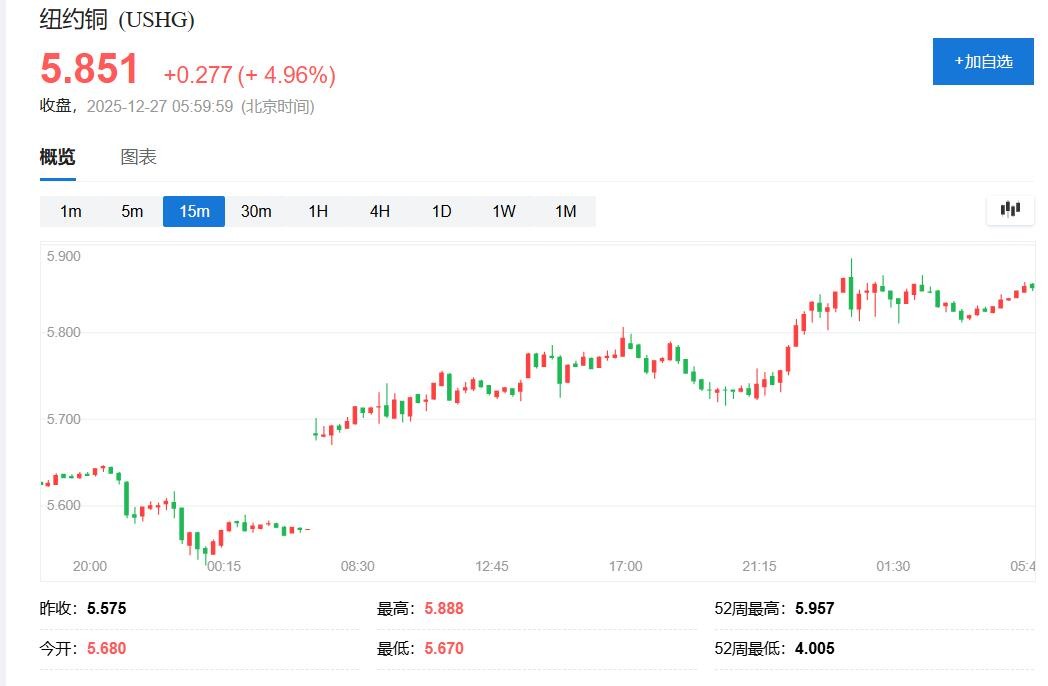
On Friday, the New York copper surged even more. By the end of Friday, the main contract for COMEX March copper was above $5.8510 per pound, up nearly 5% from the previous trading day's close, with intraday highs reaching $5.8880, surpassing the unprecedented intraday record set during the short squeeze in July this year, with a daily increase of 5.6%.

The London Metal Exchange (LME) was closed on Friday for the Christmas holiday, but in the most recent trading day, Wednesday, London copper continued its recent trend of hitting new highs. On Wednesday, LME copper closed up $102, at $12,162 per ton, marking the fourth consecutive trading day of setting a closing record.

This increase further expanded the copper price rise this year. Based on Friday's closing price, New York copper has risen about 45% this year, Shanghai copper has risen over 40%, and London copper has risen nearly 39% as of Wednesday. Concerns about supply disruptions, U.S. inventory replenishment, and demand for energy transition have collectively driven copper prices higher.

The rise in copper prices continues the overall rebound in the precious metals market at the end of the year. On Friday, gold, silver, and platinum all reached historical highs, reflecting investors' anxiety about the macro environment and urgent demand for physical assets. On one hand, expectations of interest rate cuts by the Federal Reserve and the sharp decline of the dollar have reduced the cost of holding commodities; on the other hand, national security investigations into key minerals, escalated sanctions against Venezuela, and geopolitical uncertainties have significantly heightened market risk aversion.

Weaker Dollar and Supply Concerns Drive Copper Prices Higher

The strong performance of copper prices on Friday was directly boosted by the weaker dollar. The Bloomberg Dollar Spot Index fell nearly 0.8% this week, marking the largest weekly decline since the week of June 27, making dollar-denominated commodities cheaper for most buyers.

More critically, investors are betting on a tightening global copper supply by 2026. Earlier this year, New York copper surged to record highs due to expectations that the Trump administration would impose tariffs.

According to CCTV News, on July 30 local time, the White House announced that President Trump signed a proclamation imposing tariffs on several categories of imported copper products, but excluded copper raw materials. The announcement indicated that starting from August 1, a 50% tariff would be generally imposed on imported semi-finished copper products (such as copper pipes, copper wires, copper rods, copper plates) and copper-intensive derivative products (such as fittings, cables, connectors, and electrical components) Although Trump ultimately excluded the main trading form of copper from tariffs, the White House is expected to review this tariff decision next year. Last month, Wall Street Insight mentioned that reports indicated the return of copper arbitrage trading, once referred to as "one of the most profitable commodity trades in modern history," with traders betting that the Trump administration will impose high tariffs on copper next year.

The continuous influx of copper metal into the United States has raised market concerns that buyers in other regions may eventually rush to procure to avoid potential supply shortages. In terms of demand, copper is expected to be a major beneficiary of the global energy transition, which has also helped copper become one of the top-performing major assets this year.

Precious Metals Sector Flourishes, Strengthening Commodity Bull Market

The rise in copper prices is not an isolated event; global metals generally rose in December. Silver has increased by over 170% this year, gold by over 70%, platinum by 133%, and palladium by 95%. A combination of trade disruptions, geopolitical uncertainties, and supply shocks has reshaped the entire industry landscape.

Reports this week indicated that the London silver market is experiencing a severe spot squeeze, with investors heavily selling paper silver contracts and rushing to buy physical silver, causing the key indicator "one-year silver swap spread" to drop to -7.18%, indicating extreme tightness in the spot market. Experts say this "distortion" is the core driving force behind the rise in silver prices, and under pressure from leverage and intensified arbitrage, the upward trend in silver prices may continue.

There are also reports that traders are closely monitoring the results of a U.S. Department of Commerce investigation into whether imports of critical minerals threaten national security, with market concerns that this could lead to new tariffs or trade restrictions.

The gold market remains strong, supported by rising geopolitical tensions. Recently, the U.S. has escalated oil sanctions against Venezuela and its oil trade blockade, and Trump announced that U.S. forces have launched a strong attack against the extremist group ISIS in Nigeria. These uncertainties have significantly increased the safe-haven appeal of precious metals.

According to data from the World Gold Council, global gold ETF holdings have been increasing every month this year, except for May.

Wall Street Optimistic About Copper Taking Over Silver as the Best Commodity Next Year

After silver claimed the title of the best-performing metal in the market this year, Wall Street has begun to turn its attention to copper. Several investment institutions believe that copper will be the best-performing metal by 2026.

JP Morgan is optimistic about copper due to "severe supply disruptions, weak inventories outside the U.S., and China's renewed buying," and recommends buying U.S. mining stocks—copper mining giant Freeport McMoRan. UBS shares the same view and also recommends Anglo American and Teck Resources, which are traded in London.

UBS's research report points out that while the risk and return of gold have become less favorable, it has not reached an unfavorable level. UBS holds a more positive view on copper and aluminum.

Overall, Wall Street is optimistic about the metal industry due to acute supply disruptions, weak inventory conditions, and structural demand from the energy transition The surge in metal prices reflects the cumulative effect of multiple factors. The U.S. federal government's debt has reached 115% of GDP, and the fiscal deficit has reached $1.8 trillion in the past year. The U.S. dollar index has fallen by 10% this year, while the Federal Reserve continues to cut interest rates despite inflation remaining above target. This comprehensive situation provides strong momentum for the metal market, while also driving investors to shift from paper assets to physical asset allocation