


What easing signals did the central bank reveal in the fourth quarter regular meeting regarding the flexible and efficient use of reserve requirement ratio cuts and interest rate reductions?

The Monetary Policy Committee of the People's Bank of China held its regular meeting for the fourth quarter of 2025, without explicitly mentioning "flexibly and efficiently using reserve requirement ratio cuts and interest rate reductions." The meeting emphasized that the low operation of the comprehensive financing cost in society faces constraints from interest rate comparisons, and monetary control will gradually shift to a price-based control approach. Currently, the continued decline in social financing costs faces three constraints: risk interest rate comparisons, the relationship between bank asset and liability interest rates, and the relationship between different asset yields. It is expected that reserve requirement ratio cuts and structural interest rate reductions will be implemented in the first quarter to support fiscal policy and expand domestic demand
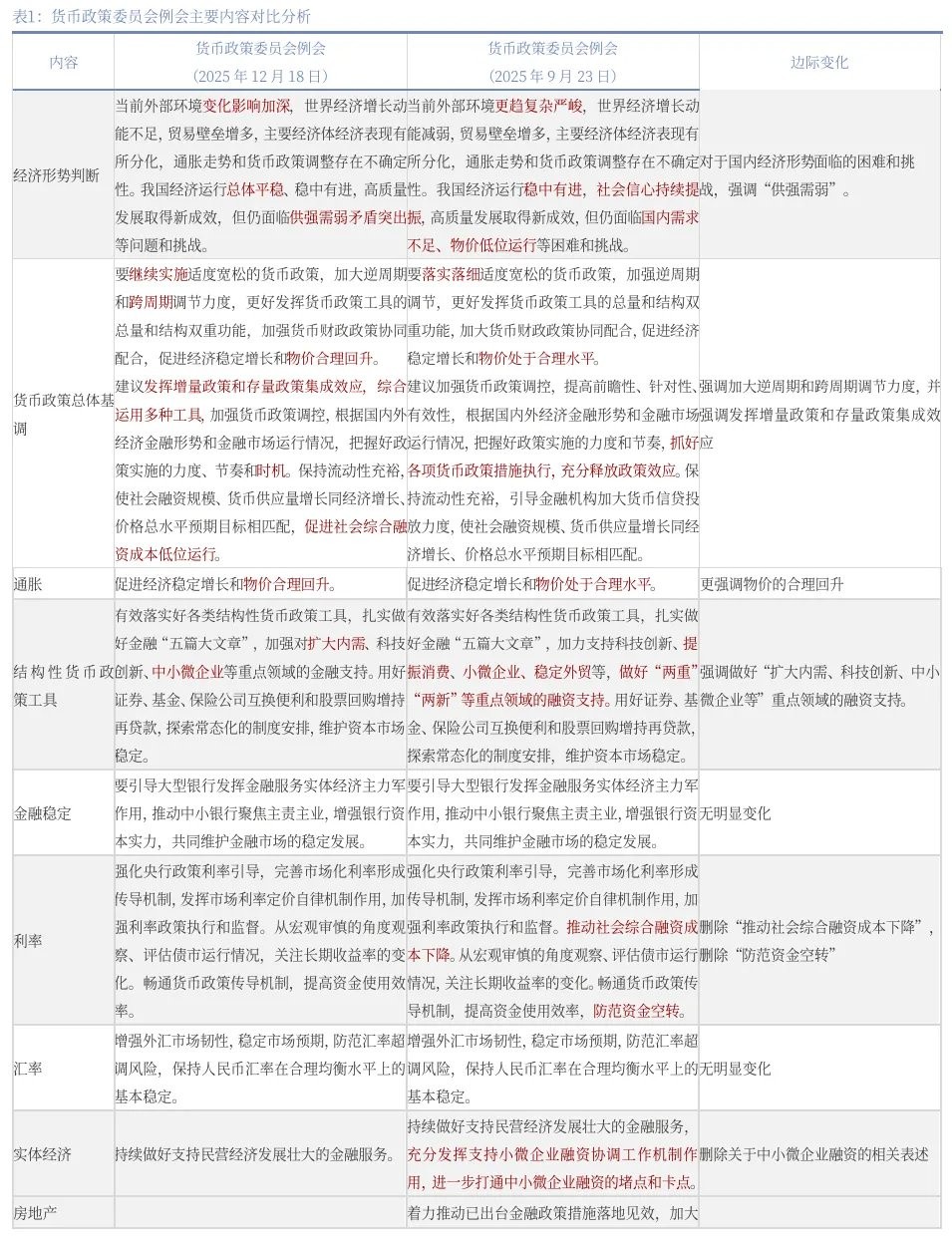
On December 18, the Monetary Policy Committee of the People's Bank of China held its quarterly meeting for the fourth quarter of 2025. The monetary policy statement continues the tone set by the Central Economic Work Conference but does not explicitly mention "flexibly and efficiently using reserve requirement ratio cuts and interest rate reductions."
The most noteworthy change from this meeting: The comprehensive financing cost for society is further constrained by the interest rate comparison. The shift from "promoting a decrease in the comprehensive financing cost for society" to "facilitating the low-level operation of the comprehensive financing cost for society" indicates that, under the current context where the comprehensive financing cost is already at a "low level," further pushing it down faces constraints from interest rate comparisons. The central bank's monetary control will gradually shift from "parallel quantity and price control" to "mainly price control," focusing on smoothing the market-oriented interest rate formation and transmission mechanism. To achieve this, a reasonable interest rate comparison must be maintained.
Recently, the yield on 10-year government bonds has risen to around 1.85%. Due to the need to maintain a reasonable comparison relationship, the current comprehensive financing cost continues to face the following three constraints: 1. The comparison relationship of different risk interest rates. That is, the risk premium must remain at a reasonable level, and corporate financing rates should not be lower than government bond yields. Therefore, the space for further declines in deposit and loan rates is constrained; 2. The relationship between asset-side and liability-side interest rates of commercial banks. Maintaining a reasonable net interest margin for banks requires a more reasonable comparison between asset-side and liability-side interest rates; 3. The relationship between the yields of different types of assets. This means that deposit rates and bond yields need to maintain a reasonable spread.
Monetary Policy Outlook: The easing path in the first quarter will be reserve requirement ratio cuts and structural interest rate reductions. First, fiscal policy will take the lead, with monetary policy actively cooperating to synergize efforts. A 50 basis point reserve requirement ratio cut is expected to be implemented, saving banks' costs and releasing about 1 trillion in liquidity, while comprehensively using tools such as open market operations to buy and sell government bonds and reverse repos to maintain ample liquidity in line with government bond issuance; second, interest rate cuts will be more flexible and efficient, with structural interest rate reductions being a better choice. Currently, the continued decline in the comprehensive financing cost faces constraints from interest rate comparison relationships, and the central bank may choose to more selectively lower the rates of certain structural monetary policy tools to support financing needs in three key areas: expanding domestic demand, technological innovation, and small and micro enterprises, while the PSL rate is also expected to be lowered;
Third, a comprehensive interest rate cut still needs to wait for the right timing. Stabilizing expectations (external), stabilizing employment (internal), and stabilizing the market (financial) will be the main lines to observe the potential implementation of a comprehensive interest rate cut. On one hand, enhancing awareness of risks; if the China-U.S. competition encounters setbacks again, monetary policy is likely to take the lead in boosting expectations. On the other hand, reinforcing bottom-line thinking; if structural unemployment pressure increases, it will drive the implementation of monetary policy easing. At the same time, risks in the real estate and financial markets may also trigger the implementation of a comprehensive interest rate cut. It is expected that there will be 1-2 interest rate cuts throughout the year, totaling a reduction of 10-20 basis points in policy interest rates, thereby guiding a decline in LPR and transmitting to further declines in loan and deposit rates Investment Insights:
Exchange Rate: The RMB exchange rate is expected to show a steady and moderate appreciation in 2026, approaching 6.9 by the end of the year. The factors driving the appreciation of the RMB come from the recovery of China's nominal economic growth rate, more significant interest rate cuts by the Federal Reserve, and an improvement in the supply-demand relationship under the upward spiral formed by exchange rate appreciation expectations and their self-fulfilling nature.
Stocks: Investing in the Chinese stock market is expected to yield excess returns, with a focus on "spring excitement" investment opportunities. As an important hub for the transformation of old and new driving forces, the capital market plays a significant role in "riding the momentum" (supporting technology and high-quality development) and "guiding based on the situation" (boosting confidence and wealth effects). A positive cycle is formed between medium- and long-term capital entering the market and the rise of the stock market, further driving the relocation of household deposits.
Bonds: Influenced by the mild recovery of inflation, gradual bottoming of housing prices, declining risk premiums, the stock-bond seesaw effect, and monetary easing by the central bank. It is expected that the yield on 10-year government bonds will remain between 1.6% and 1.9%, with an overall trend of high first and low later.
Commodities: The gradual bottoming of housing prices and the mild recovery of inflation will provide more support for the prices of domestic commodities priced in RMB.
Risk Warning and Disclaimer
The market has risks, and investment requires caution. This article does not constitute personal investment advice and does not take into account the specific investment goals, financial situation, or needs of individual users. Users should consider whether any opinions, views, or conclusions in this article align with their specific circumstances. Investing based on this is at one's own risk
