"China may not be able to do it"! AI bubble fills Texas: Over 220GW large projects applied to enter the grid by 2030

Wallstreetcn
2025.12.12 22:32
portai
I'm PortAI, I can summarize articles.

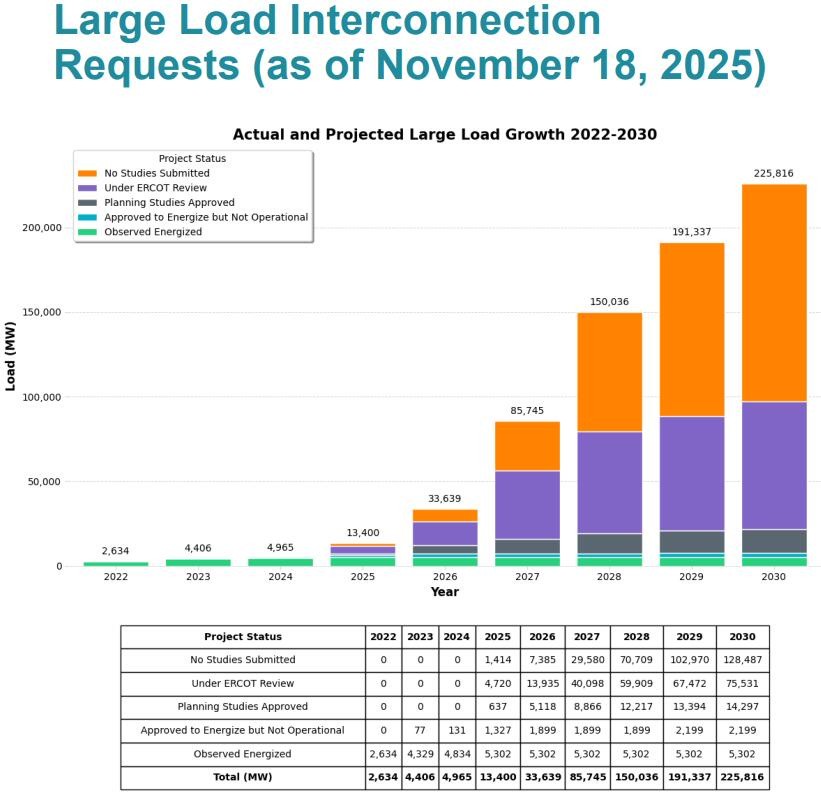
The Texas grid management agency ERCOT reported that the total capacity of large projects applying to connect to the Texas grid before 2030 has exceeded 220 GW, more than double the peak demand in the state this summer, with over 70% being data centers. The number of large projects applying for power interconnection in Texas this year has nearly quadrupled, with more than half, approximately 128 GW of projects, yet to be submitted for ERCOT review

Texas is experiencing a crazy construction boom of data centers, the scale of which has raised warnings of a bubble among industry insiders. Data center projects driven by the AI boom are flooding into the state, and energy experts say that this demand simply cannot be met.

According to a report released earlier this week by the Electric Reliability Council of Texas (ERCOT), the total capacity of large projects applying to connect to the Texas grid before 2030 has exceeded 220 gigawatts (GW). ERCOT data shows that over 70% of this is from data center projects. 220 GW is more than double Texas's record summer peak demand of about 85 GW this year and far exceeds the state's total quarterly generation capacity of about 103 GW.

Joshua Rhodes, a research scientist at the University of Texas at Austin and founder of the energy consulting firm IdeaSmiths, bluntly stated:

"It absolutely looks, smells, and feels—like a bubble. The overall numbers are just ridiculous.

We have no way to build that much infrastructure on the ground to meet these numbers. I don't even know if China can do it that quickly."

This boom has also sparked broader credit concerns. Howard Marks, co-founder of Oaktree Capital Management, wrote in a report this week:

"A key risk to consider is that the data center construction boom could lead to oversupply. Some data centers may become unprofitable, and some owners may go bankrupt. We will see which lending institutions can remain rational in this exciting environment."

Behind the "crazy" demand numbers

The scale of the numbers from ERCOT in Texas has shocked seasoned industry professionals. Beth Garza, who served as the Director of the Independent Market Monitor for ERCOT from 2014 to 2019, stated that these numbers are "crazy big," and "there is not enough on either the supply or consumption side to meet such a large load."

Cheap land and cheap energy have attracted a large number of data center developers to Texas. Rhodes stated that it will be impossible to meet such a large demand by the end of 2030.

In 2023, Texas legislation required that projects without signed power connection agreements be included in power demand forecasts. Since then, the number of data center applications in the state has surged. This year, the number of large projects applying for power access has nearly quadrupled. However, more than half of these projects, representing about 128 GW of new potential demand growth, have not submitted studies for ERCOT review. An additional approximately 90 GW is under review or has received planning study approval.

Michael Hogan, a senior advisor at the Regulatory Assistance Project, stated:

"We know that not all demand is real. The question is how much of it is."

Hogan has worked in the power industry for over 40 years, starting his career at General Electric in 1980. He said that the huge numbers in Texas reflect a broader data center bubble in the U.S., "like everything else in Texas, this is a massive example."

The actual number of projects that have been integrated into the grid or approved by ERCOT is much smaller, with a capacity of only about 7.5 GW. Nevertheless, this is still a fairly large number, equivalent to the power of nearly eight large nuclear power plants.

However, Rhodes stated that Texas can meet this level of demand. He said, "We can easily develop 8 GW of data centers," and by 2030, Texas may be able to meet the demand for 20 GW or 30 GW of data centers.

Texas Takes Action to Curb Speculation

Texas has taken steps to distinguish serious data center projects from purely speculative ones. In May, the state passed a law requiring developers to pay $100,000 for preliminary studies of their projects and to demonstrate that the site is secured through ownership or lease. They must also disclose whether they have outlined the same project elsewhere in Texas.

The Texas Public Utility Commission proposed a rule requiring data centers to pay a $50,000 deposit for each megawatt of peak power. For gigawatt-level data centers, developers' costs will be at least $50 million.

Rhodes stated, "Serious developers who sign long-term contracts with core tenants will be willing to pay this money." More speculative developers may drop out of the power interconnection queue, which will help authorities obtain more accurate forecasts.

Investors Face Risks

Rhodes indicated that the risk lies in potentially building power infrastructure such as power plants, transmission lines, and transformers for speculative data centers that fail to materialize or have lower-than-expected electricity consumption. Moreover, overbuilding will occur at a time when these infrastructure costs are soaring, as data centers and other industries compete for the same scarce equipment.

Rhodes explained, "When the bubble bursts, who pays will depend on how much steel has already been invested." For example, the cost of gas power plants has more than doubled in the past five years. Rhodes likened it to:

"It's a bit like buying a house at the top of the market. If the house price drops five years later, you're out of luck."

Rhodes and Hogan noted that the costs of building new power plants for the Texas electricity market are typically borne by investors, which provides some level of protection for households from rising electricity prices if too much capacity is built.

In contrast, electricity prices in some Midwestern and Mid-Atlantic states have soared due to data center demand, as grid operator PJM Interconnection purchased power years in advance—placing the burden on consumers. In Illinois, where PJM serves the northern part of the state, residential electricity prices in September rose about 20% compared to the same period last year. However, Texas's electricity prices rose only 5% year-on-year, below the national average increase of over 7%, according to the U.S. Energy Information Administration Hogan stated that due to the way the market is structured, the risk of overbuilding in Texas is lower than in the states served by PJM. "Regardless of what new facilities we ultimately see in Texas, those who invest in excess capacity will be the ones to suffer."

Madness and Concerns in the Credit Market

The boom in AI data centers is raising concerns about a debt financing frenzy, as companies are using financial engineering to exclude liabilities from their balance sheets. A typical example is the nuclear startup Fermi Inc., which has not yet developed any data centers but saw its valuation soar to over $19 billion at the time of its IPO this year, making company founder Toby Neugebauer and former U.S. Energy Secretary Rick Perry's son Griffin Perry billionaires.

Reports this Friday indicated that some estimates suggest the total cost of infrastructure construction could reach $10 trillion, with so many lenders queuing up to invest in these assets, raising concerns that a bubble is forming, which could ultimately cause significant pain for equity and credit participants.

Lenders are slicing and segmenting debt and selling it to other investors, making it increasingly opaque. Some borrowers are using the securitization market to transfer the risks of AI data centers off their balance sheets, with the debt being divided into portions with different risks and returns, purchased by institutions such as insurance companies and pension funds.

The media mentioned that two individuals from private lenders stated that in such a favorable lending environment, some borrowers are even requesting loans that exceed project construction costs by 100%. One case showed that the loan-to-cost ratio requested by lenders reached 150%, with real estate developers justifying this request by citing the increase in valuation once facilities start generating rental income.

Data compiled by the media shows that at least $175 billion in U.S. credit transactions related to data centers have been completed so far this year.

Howard Marks questioned the debt yields sold by hyperscale cloud service providers to fund AI investments. Sometimes the spread is only about 100 basis points higher than U.S. Treasuries, leading this investment veteran to wonder, "Is it prudent to accept 30 years of technological uncertainty for fixed-income investments when the yield is only slightly above risk-free debt?"

On the regulatory front, the UK is increasingly concerned about spending and financing levels and is reviewing loans to data centers.

Scott Wilcoxen, head of JPMorgan's global digital infrastructure investment banking business, noted a phrase emerging in the market to describe the massive financing: "Everything everywhere all at once," a parody of the recently Oscar-winning film. He stated, "The scale of the funds chasing all of this is staggering."