


Goldman Sachs strategists: AI and strong macroeconomic factors will drive U.S. corporate earnings to jump 12% next year, with the S&P pointing to 7600 points

Goldman Sachs expects that the acceleration of AI applications and the resilience of the U.S. economy will drive U.S. stocks to set new records in 2026, with S&P 500 companies' earnings per share expected to grow by 12% next year and an additional 10% in 2027, with the index potentially rising to 7,600 points next year. Large technology companies remain the core driving force of profits, with AI bringing initial productivity dividends, and several Wall Street institutions are also bullish
Goldman Sachs strategists predict that with the widespread application of artificial intelligence technology and resilient economic growth in the United States, the U.S. market will reach new highs next year, with corporate earnings expected to see a double-digit leap.
The Goldman team, led by Ben Snider, pointed out in their latest report that the earnings per share of S&P 500 constituent companies are expected to jump 12% next year, with further growth of 10% by 2027. Based on the improvement in earnings expectations, the bank reiterated its target for the S&P 500 index to trade around 7,600 points next year, indicating that U.S. stocks still have about a 10% upside from current levels.
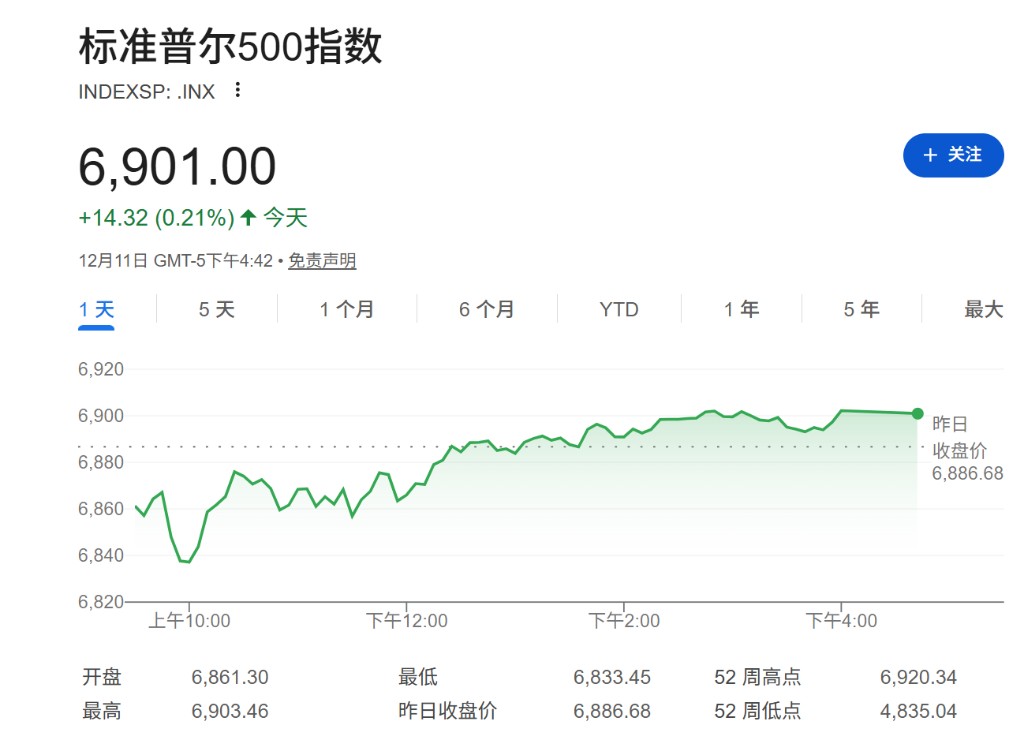
This optimistic outlook has been echoed by several major institutions on Wall Street. According to Bloomberg, strategists from Morgan Stanley, Deutsche Bank AG, and RBC Capital Markets LLC all expect U.S. stocks to achieve over a 10% increase by 2026. Although there are concerns that massive spending on artificial intelligence could trigger a bubble, investor confidence in the economic outlook is driving major indices to continuously set new records.
Ben Snider will succeed David Kostin as Goldman Sachs' Chief U.S. Equity Strategist at the end of this year. He emphasized that large technology companies will continue to lead, while the easing of tariff burdens and healthy revenue growth will jointly support strong market performance.
AI Productivity Dividend Begins to Emerge
Goldman Sachs' predictive model shows that productivity gains driven by artificial intelligence are gradually translating into actual corporate profits. Of the expected 12% earnings per share growth next year, productivity improvements from AI will contribute about 0.4 percentage points; while in the 10% growth expectation for 2027, the contribution rate of AI will expand to 1.5 percentage points.
Ben Snider wrote in the report that the adoption of artificial intelligence is still in its early stages, but the progress reported by large companies has been significantly faster than that of small businesses. He expects that thanks to healthy baseline revenue growth, the gradual fading of negative impacts from tariffs, and the continued strong profitability of weighted stocks in the index, the fundamentals of U.S. stocks will remain robust.
Despite improvements in market breadth, the technology sector will still be the core driver of overall earnings growth next year. Goldman expects that the largest companies in the S&P 500 index by market capitalization—including Nvidia, Apple, Microsoft, Google, Amazon, Broadcom, and Meta—will contribute about 46% of the index's profit growth by 2026, a proportion slightly lower than this year's level.
Additionally, according to analyst expectations tracked by Bloomberg Industry Research, driven by an 18% net profit growth from the "seven giants," the net profits of S&P 500 constituent companies are expected to jump 14% overall in 2026.
This bullish sentiment is also quite prevalent in the asset management industry. An informal survey conducted by Bloomberg shows that global fund managers are betting that this round of rebound will continue, with market confidence primarily stemming from optimism about the economic outlook However, the market is not without concerns. Some market participants remain cautious about the large-scale capital expenditures of tech giants on artificial intelligence infrastructure, fearing that this could lead to a valuation bubble in tech stocks. Nevertheless, mainstream institutions are currently maintaining a Risk-On mode, betting that corporate earnings growth can absorb the high valuations
