


PSBC accelerates "efficiency revolution": How nearly 40,000 outlets seek to enhance profitability

On December 10th, a personnel change at PSBC attracted market attention. According to reports, Yang Xilin, the general manager of the bank's financial industry department, has been appointed as a member of the company's party committee
On December 10th, a personnel change at Postal Savings Bank of China attracted market attention.
Reports indicate that Yang Xilin, the general manager of the bank's financial interbank department, has been appointed as a member of the company's party committee and may further take on the role of director of the company's financial market business in the future. Previously, Postal Savings Bank only had a retail director and did not establish a financial market director position.
This appointment reveals Postal Savings Bank's desire for change in its business structure and its focus on financial market business beyond retail.
Xinfeng noted that Postal Savings Bank has closed 265 branches and opened 65 new ones this year, leading the six major banks in both the number of closures and new openings;
This means that while Postal Savings Bank is shrinking its branch network, it is also reallocating internal resources faster than its peers.
These two seemingly unrelated pieces of news together form a microcosm of Postal Savings Bank's "efficiency revolution";
What Postal Savings Bank truly needs to address now is how to transform the network advantages in lower-tier markets into core profitability.
The Pain of Efficiency
In the first three quarters, Postal Savings Bank recorded revenue and net profit of 265.08 billion yuan and 76.562 billion yuan, with year-on-year growth rates of 1.82% and 0.98%, respectively, ranking in the middle among peers, and fourth among the six major banks;
However, there is no significant gap among the banks, with only Bank of China leading Postal Savings Bank in both revenue and net profit growth.
Currently, the revenue contribution rates of Postal Savings Bank from interest, fee income, and investment income are 79.41%, 8.71%, and 11.94%, respectively.
From the perspective of "volume, price, and risk," Postal Savings Bank's core lending business maintains leading levels among peers in various indicators:
First, it maintains a high pace of balance sheet expansion, with assets and liabilities growing by 8.9% and 8.64% respectively since the beginning of the year, with a loan growth rate of 8.68%, the highest among the six major banks;
Second, it leads in net interest margin, with a net interest margin of 1.68%, the highest among the six major banks, exceeding Bank of China by 50 basis points;
Third, it has superior asset quality, with a non-performing loan ratio of 0.94%, the best level among the six major banks, and a provision coverage ratio of 240.21%, second only to Agricultural Bank of China.
It can be observed that under the current cycle, several key indicators of Postal Savings Bank are the best among peers;
This is not difficult to understand, as the potential of lower-tier markets has been repeatedly validated in industry events where Agricultural Bank's market value surpassed that of Industrial and Commercial Bank amid falling housing prices, depreciating assets, and significantly reduced consumer willingness.
County areas are precisely the main battlefield for Postal Savings Bank. Since its establishment, Postal Savings Bank has developed nearly 40,000 business outlets relying on the advantages of "self-operated + agency," covering about 99% of counties (cities), with 70% of outlets located in counties and below.
This brings a unique advantage to Postal Savings Bank's liability side:
In county areas, safety is the primary demand for deposits among most residents, and financial products in county areas are often limited, lacking deposit substitutes, making them less sensitive to interest rate cuts. County banks can thus obtain low-cost liabilities.
For example, Postal Savings Bank's yield on interest-earning assets in the first half of the year lagged behind that of Bank of Communications by 9 basis points, but its cost of interest-bearing liabilities was ahead by 110 basis points; Under the overlay, PSBC's net interest margin of 1.68% overall leads Bank of Communications by 48 basis points.
However, as a major bank deeply rooted in county areas, PSBC's valuation in the capital market has always been limited, with a year-to-date increase in A-shares only in single digits, lagging behind ICBC, CCB, and BOC.
This may be because, in the current cycle, PSBC's biggest problem lies not in fundamental growth, but in operational efficiency.
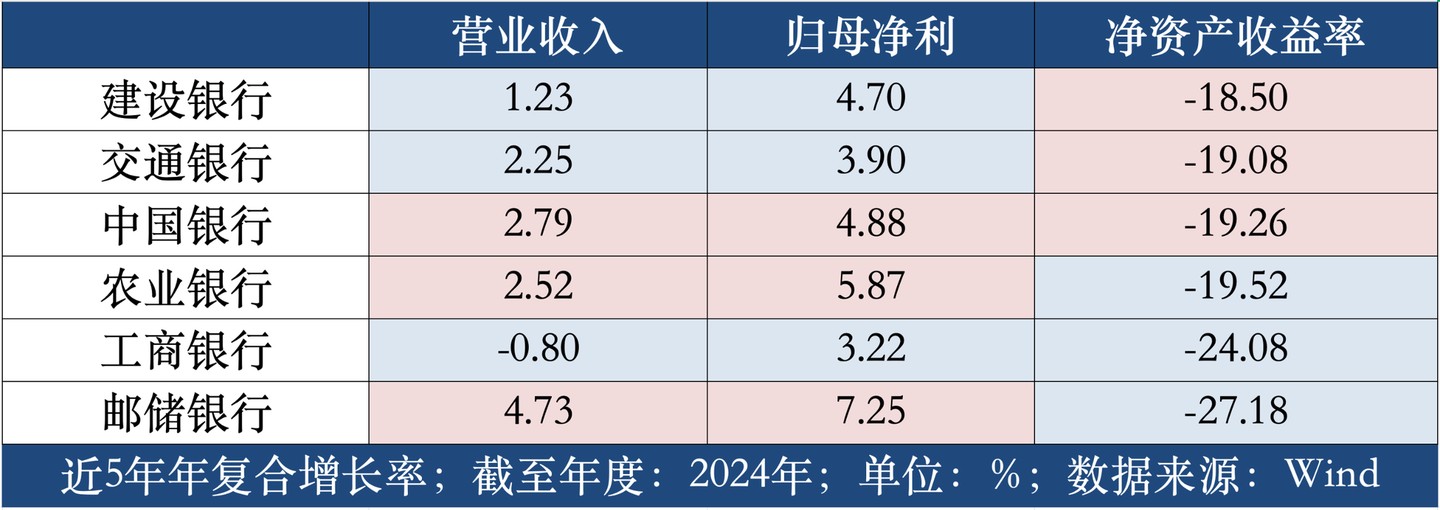
Taking the 5-year compound annual growth rate as an example, by 2024, PSBC's revenue and net profit attributable to the parent company will have compound growth rates of 4.73% and 7.25%, respectively, ranking first among the six major banks;
However, the return on equity is -27.18%, ranking last among the six major banks.
Other efficiency indicators can also serve as a reference:
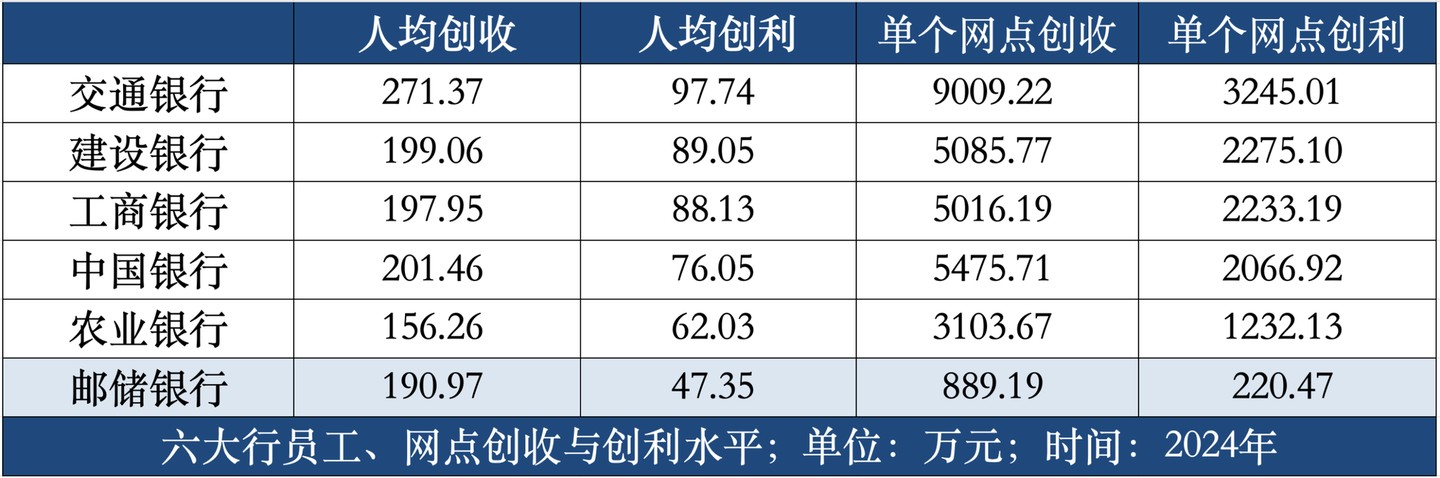
In 2024, PSBC's revenue per capita and profit per capita will be 1.9097 million yuan and 473,500 yuan, respectively, ranking 5th and 6th among the six major banks; the revenue and profit per outlet will be 8.8919 million yuan and 2.2047 million yuan, both ranking 6th among the six major banks, and significantly distant from the other five major banks.
This is the other side of PSBC's county business—
PSBC's agency model uses the postal system's outlets as business locations, paying agency fees to the postal system based on deposit balances.
This allows PSBC to save on some initial fixed expenses such as labor and venue, enabling low-cost penetration into the county areas across the country; however, the limited business scope of the outlets and high agency fees also pose challenges to PSBC's outlet efficiency.
As of the end of 2023, among PSBC's 39,364 business outlets, the ratio of self-operated to agency outlets is 20% to 80%;
According to rough estimates by Jingxin Feng, deposits absorbed by the postal system's agency outlets account for about 60-70% of the annual deposits;
At that time, PSBC's cost of interest on deposits was 1.56%, and the savings agency fee rate paid to the postal system was 1.24%. After comprehensive calculation, more than 30% of the revenue was used to pay agency fees, becoming the largest expenditure item in history.
According to the agreement between PSBC and the postal system, the pricing of savings agency fees can be actively and passively adjusted.
However, in recent years, as the interest margin of state-owned banks has rapidly declined, passive rate adjustments have always lagged behind changes in interest margins:
Although the tiered agency fee rates between the two parties triggered passive adjustments twice in 2022 and 2024, from 2021 to 2024, the overall rate reduction of the bank was only 14 basis points, while the net interest margin reduction reached 51 basis points.
The outlet efficiency dragged down by the fee rates has gradually become the biggest constraint for PSBC to "move up to the next level."
Channel Transition
Observing with efficiency as the keyword, it seems clearer to understand the transformation of Postal Savings Bank of China in recent years.
For example, by cutting down inefficient branches to reduce costs, the bank has netted a reduction of 153 outlets from 2020 to mid-year this year, and in the third quarter of this year, it absorbed and merged its direct sales bank, Youhui Wanjia, stating "to reduce the overall operational costs of the bank";
Another example is the initiation of a systematic transformation of outlets, with a three-year plan for improving outlet efficiency set in 2023, and this year further clarifying the reform route, directly targeting key areas such as regional layout and channel efficiency.
In summary, the current channel strategy of Postal Savings Bank is divided into two paths: one is to focus on high-capacity cities with self-operated branches that have more business and stronger capabilities, and the other is to continue extending into lower-tier markets with lower-cost agency outlets while actively improving the efficiency of individual outlets.
On one hand, it is optimizing resource allocation between regions, mainly reflected in the closure and establishment of outlets, as well as the trade-offs between self-operated and agency models.
According to statistics from Xinfeng, as of December 8, Postal Savings Bank has closed a total of 265 outlets and established 65 this year, showing a net reduction trend;
Among them, 150 branches were closed, and 6 were newly established, while 115 agency outlets were closed and 59 were newly established;
Between the reduction and increase, the proportion of outlets named after agency outlets under the postal system has shown an upward trend.
According to regulatory requirements, Postal Savings Bank establishes agency outlets, which in principle need to be in county and below areas, focusing on serving urban-rural junctions and financial service-weak towns or areas, addressing the "last mile" issue;
Although the number of closures has increased, Postal Savings Bank has not given up on its determination to continue developing lower-tier markets through new touchpoints.
At the same time, Postal Savings Bank is advancing "urban business breakthroughs" as one of the "five major actions" to fill the urban shortfall, focusing on high-activity, multi-entity key areas and parks to tap into market gaps, and making efforts in urban renewal and infrastructure construction.
The 6 newly established branches this year are more distributed in urban areas rather than towns.
On the other hand, it is enhancing the efficiency of individual outlets through image upgrades, digital empowerment, and fee adjustments.
In 2021, the bank replaced outdoor signage for nearly half of its outlets, and in 2022, it established a comprehensive indicator system for outlet efficiency evaluation;
In 2024, it will accelerate technological empowerment and centralized operations, promoting "remote + on-site" services, releasing tellers to transform into service or marketing personnel, and improving the per capita productivity of "individual operations."
In addition, Postal Savings Bank has begun to proactively adjust the fee rates with the postal system:
After two passive adjustments, Postal Savings Bank will proactively adjust the agency fee pricing for the first time in the second half of 2024 and optimize the conditions for passive triggers;
This year, the bank's vice president Xu Xueming revealed that after the adjustment, the "scissors gap" between the company's agency fees and revenue growth has rapidly narrowed, stating, "How to turn the characteristics of self-operated + agency into an advantage is a very important topic. This time we chose to make a proactive adjustment."
In the first half of 2025, the bank's savings agency fees and others decreased by 8.91% year-on-year, with the growth rate significantly lower than the revenue change;
Postal Savings Bank stated that this change is driven by "proactively adjusting the savings agency fee rates for personal deposit business." Xu Xueming revealed that the bank is still making efforts to reduce its reliance on agency fees:
First, by guiding agency outlets to reduce the interest cost of agency deposits through value deposits;
Second, by transferring upwards, turning the clients of agency outlets into bank clients;
Third, by empowering downwards, allowing agency outlets to play a greater role under the premise of regulatory policy allowance and controllable risks.
"If this effect can be achieved, it will allow agency finance to increase revenue points and reduce reliance on agency fees, especially enabling PSBC's services to penetrate further," Xu Xueming said.
Beyond regions and channels, PSBC is showing intentions to strengthen its corporate financial services in financial markets and asset management, striving to further enhance asset utilization efficiency and overall effectiveness.
The most representative example is that the former general manager of the bank's financial interbank department, Yang Xilin, has publicly appeared as a member of the party committee and may serve as the newly established director of financial market business, becoming one of the seven core executives of the bank;
Yang Xilin will be fully responsible for the three major business segments of financial markets, financial interbank, and asset management.
In the first three quarters of this year, PSBC's return on equity was 6.98%, ranking third among the six major banks;
With multiple reform measures in place, whether PSBC can successfully release the results of efficiency innovation and transform its unique channel advantages into tangible profit advantages will require time to verify
