"Not raising the guidance for fiscal year 2026" is not a big issue, Goldman Sachs: increasingly confident in Broadcom's AI business

Goldman Sachs stated that Broadcom's performance in the fourth fiscal quarter was strong, with a significant increase in AI revenue, but it may face short-term pressure due to not raising the full-year guidance for fiscal year 2026. The firm still maintains a "buy" rating, believing that its position in the custom chip sector is solid, and the growth rate of its AI business is underestimated, expecting it to continue to outperform in the medium to long term. The order backlog reached $73 billion, with new customers and large orders strengthening growth momentum
Despite Broadcom not raising its full-year earnings guidance for fiscal year 2026 as some investors had expected, and potentially facing short-term pressure on its stock price, Goldman Sachs still reiterated its "Buy" rating on the company. The Wall Street giant believes that Broadcom's dominance in the custom chip sector is strengthening, and its AI business fundamentals have never been more solid.
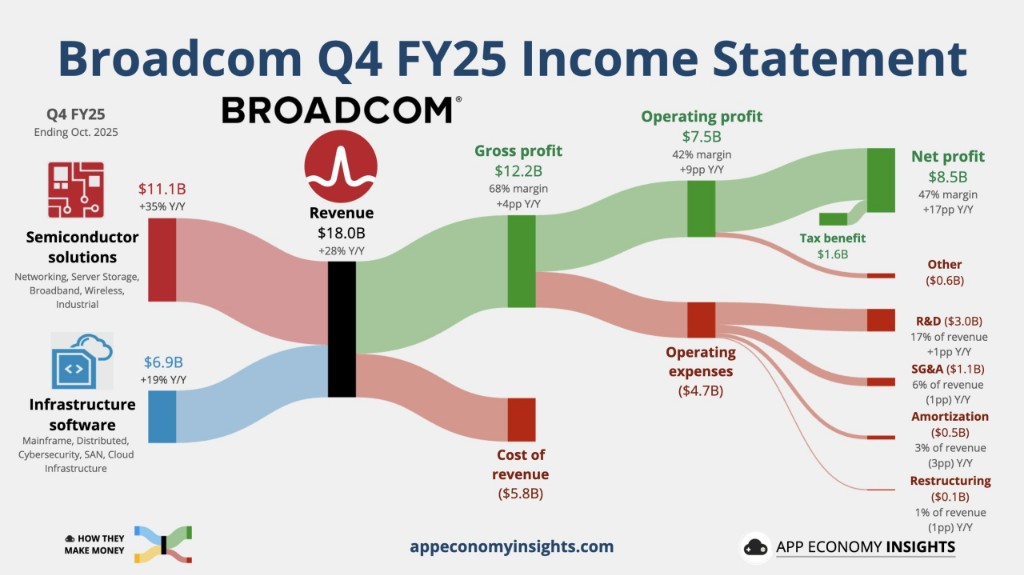
According to Wind Trading Desk, Broadcom reported a strong Q4 earnings, with revenue reaching $18 billion, exceeding market expectations of $17.5 billion. More critically, the company provided a revenue guidance of $19.1 billion for Q1 of fiscal year 2026, significantly higher than analysts' expectations of $18.3 billion. This growth is primarily attributed to a surge in AI semiconductor revenue, which saw a 74% year-over-year increase in Q4.
However, the market's reaction to this earnings report may be mixed with disappointment. Goldman Sachs analyst James Schneider's team noted in their latest research report that despite the strong performance and optimistic outlook for Q1, management did not update or raise its previously issued full-year AI revenue growth guidance for fiscal year 2026. Given that investors had already taken bullish positions ahead of the earnings release and that the AI business itself is showing signs of acceleration, the lack of a formal upward revision to the full-year guidance may be viewed as a disappointment, potentially leading to a short-term pullback in the stock price.
Nevertheless, Goldman emphasized that this does not change its long-term bullish logic and raised Broadcom's 12-month price target from $435 to $450. Goldman stated that any weakness in the stock price should be seen as a buying opportunity. The firm is confident that Broadcom's advantages in the custom chip (XPU) sector are establishing its core position in the low-cost inference market for hyperscale computing enterprises, and sustained demand from major clients like Google will drive its AI business to continue outperforming peers in the medium to long term.
Unupdated Full-Year Guidance May Trigger Pullback
During the earnings call, although Broadcom's management stated that AI revenue is accelerating from a 65% growth rate in fiscal year 2025 and expects approximately 100% growth in Q1, they did not provide a formal update on the AI revenue growth expectations for fiscal year 2026.
James Schneider wrote in the report, Given the market's lack of upward potential for the 2026 fiscal year guidance revision, despite strong quarterly performance and guidance exceeding Wall Street expectations, a pullback in the stock price is still anticipated. Investors had previously established constructive positions, so this "missing guidance update" may dampen market sentiment in the short term.
However, based on its own industry research model, Goldman predicts that Broadcom's AI revenue growth in fiscal year 2026 will actually far exceed 100%. Analysts believe that management's conservatism does not reflect the actual business momentum, and Goldman’s confidence in Broadcom's AI business continuing to outperform the market is increasing
Expansion of AI Client Landscape: Anthropic's $10 Billion Order and New Clients
Setting aside guidance issues, Broadcom has made substantial progress in customer expansion. Reports indicate that Broadcom has not only maintained strong momentum with its largest customer, Google, on the TPU project but has also disclosed new significant client developments.
Goldman Sachs emphasized that Broadcom has announced the acquisition of its fifth XPU client (clearly stated as not OpenAI), which will begin generating early revenue in fiscal year 2026. Additionally, as Broadcom's fourth-largest XPU client, Anthropic has added up to $11 billion in orders for fiscal year 2026.
The current order backlog also confirms strong demand. Management revealed that the AI order backlog for the next 18 months has reached $73 billion, and this figure continues to grow with additional orders. Besides Google, management also mentioned that other clients, including Apple and Cohere, have begun using its TPU-related technologies, although two existing clients are still focused on their custom chip projects.
Exceeding Expectations in Financial Performance and Margin Trends
From the specific financial data, Broadcom's performance has significantly exceeded the consensus expectations of Goldman Sachs and Wall Street. In the fourth fiscal quarter, the company's AI semiconductor revenue reached $6.5 billion, above the expected $6.2 billion; total semiconductor solutions revenue was $11.1 billion, exceeding the expected $10.7 billion; and infrastructure software revenue was $6.9 billion, also slightly above expectations.
In terms of profitability, Broadcom's gross margin for the fourth fiscal quarter was 77.9%, slightly above market expectations. For the first quarter of fiscal year 2026, the company provided guidance for an adjusted EBITDA margin of 67%.
Notably, Goldman Sachs mentioned in the report that as Broadcom begins delivering full-rack solutions to Anthropic and potentially OpenAI in the second half of fiscal year 2026, the higher proportion of direct components in these solutions may dilute gross margins and operating margins to some extent on a percentage basis. However, the company expects this business to maintain a strong accretive effect in absolute dollar terms and to offset some dilution effects through operational leverage and other cost optimization measures.

Valuation Logic and Risk Factors
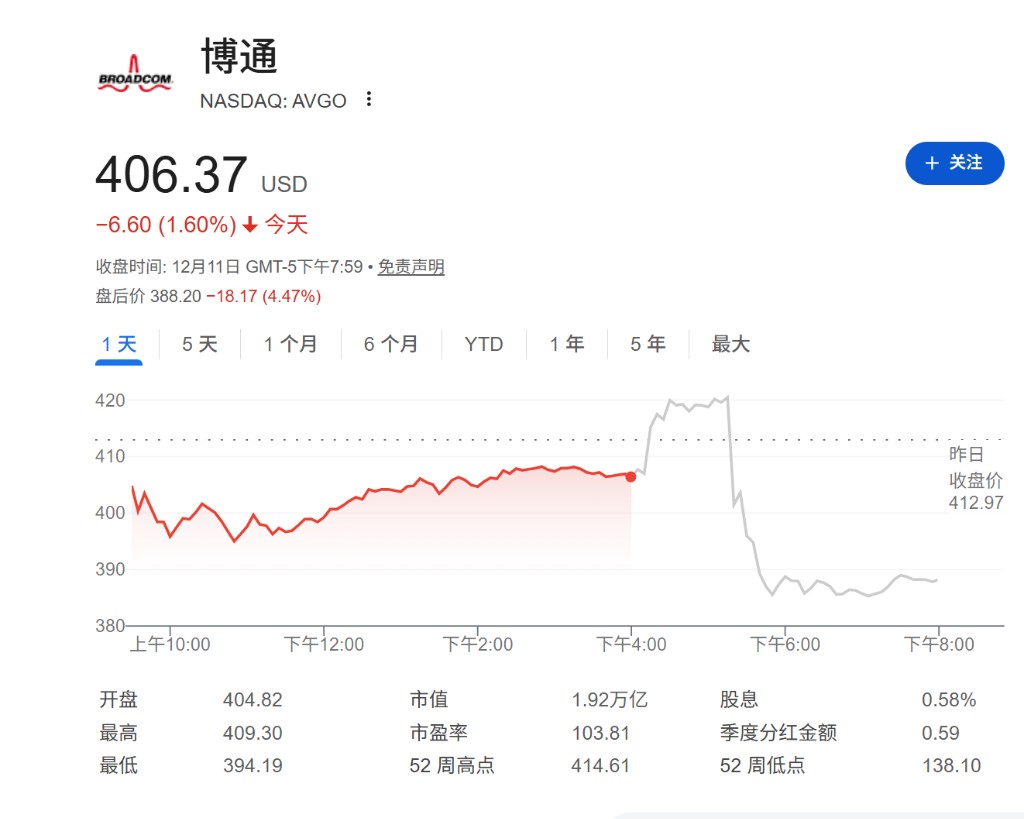
Based on the upward revision of AI revenue expectations and greater visibility into the industry cycle, Goldman Sachs has maintained the 38x price-to-earnings multiple but raised the normalized earnings per share (EPS) estimate from $11.50 to $12.00, resulting in a new target price of $450. As of the time of publication, Broadcom's after-hours trading fell 4.47% to $406.
Goldman Sachs reiterated that Broadcom's dominance in the custom chip sector enables it to provide low-cost inference solutions for hyperscalers and model builders, which constitutes the core of its investment logic.
At the same time, the report also listed the main downside risks faced by the stock, including: a slowdown in AI infrastructure spending, loss of market share in the custom computing sector, ongoing inventory digestion issues in non-AI businesses, and intensified competition faced by VMware