


China's passenger car sales in November fell by 8.5% year-on-year, with gasoline vehicle sales down by 22%, while new energy vehicles grew by 4.2%

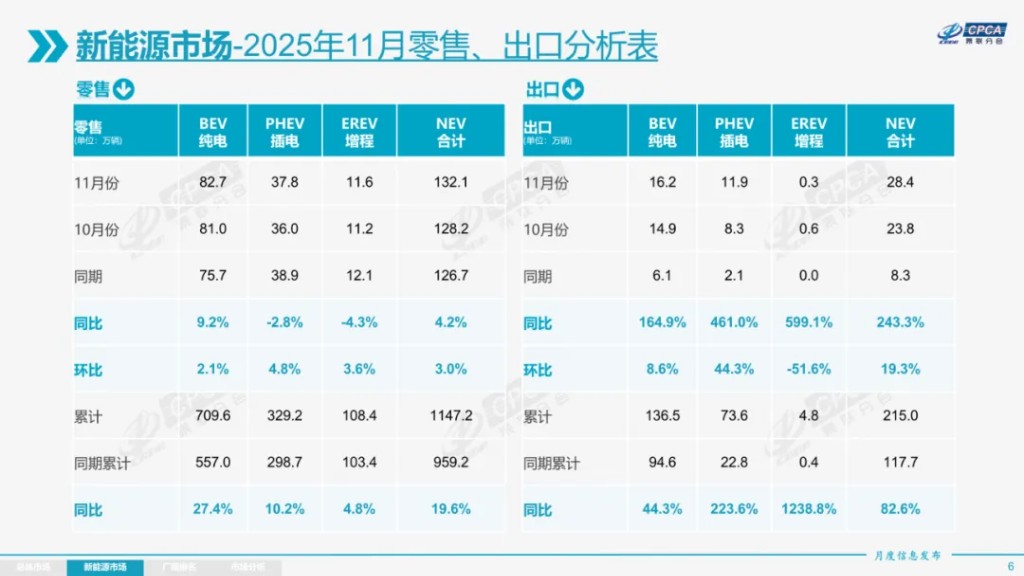
In November, China's passenger car sales fell for the second consecutive month, down 8.5% year-on-year to 2.24 million units, mainly due to a 22% decline in fuel vehicles and the tapering of subsidy policies. Although the proportion of new energy vehicles reached a record high of 58.9%, the growth rate of only 4.2% was insufficient to offset the decline. Exports became a bright spot for growth, increasing by 52.4% in November, with institutions predicting a 40% increase in new energy vehicle exports next year to 2.83 million units
On December 87, the China Passenger Car Association announced that in November, national passenger car sales declined for the second consecutive month, falling 8.5% year-on-year to 2.24 million units, marking the largest drop in 10 months, with the decline widening from 0.8% in October.
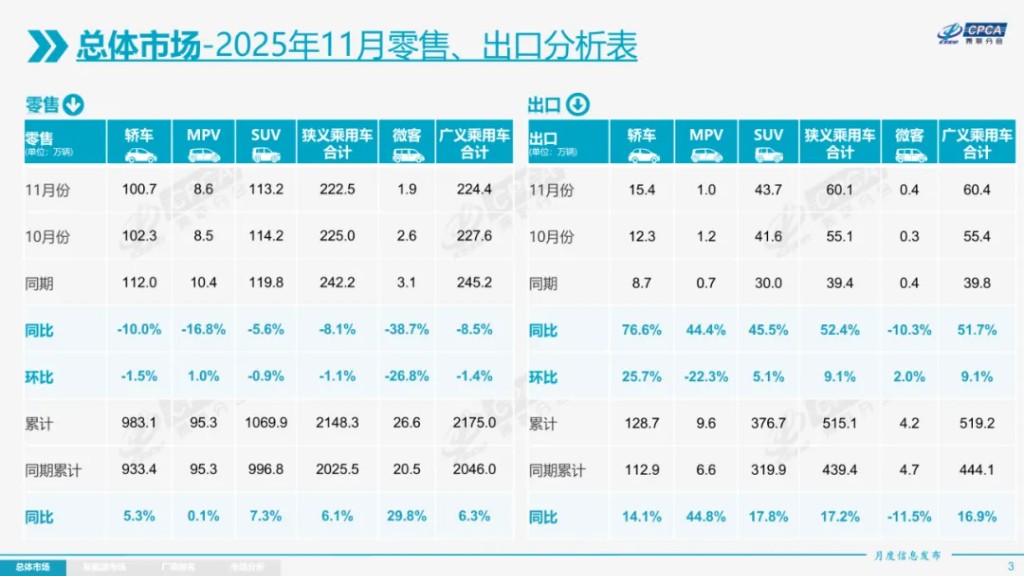
Analysis indicates that adjustments to government subsidy policies have become the main reason for the decline in sales. The trade-in subsidy has been reduced or suspended in many areas, while the purchase tax exemption for new energy vehicles will be halved in 2026, affecting consumer sentiment towards purchasing vehicles.
Although the sales share of electric vehicles and plug-in hybrid vehicles reached a historic high of 58.9%, it was unable to offset the significant 22% drop in traditional fuel vehicles. However, exports have become a new engine for growth, with some institutions predicting that next year, the export volume of new energy vehicles and plug-in hybrid vehicles will increase by 40% compared to this year.
Regarding the passenger car data for November, Cui Dongshu, Secretary-General of the China Passenger Car Association, stated that this deep decline is "abnormal," as sales typically perform strongly in the last two months of the year. He compared the current situation to the consumption pressure period in 2008, stating that "similar abnormal situations also occurred in 2008." Nevertheless, he expects annual sales to still grow by 5%.
The decline in fuel vehicle sales drags down overall performance
According to reports, Cui Dongshu attributed the overall sales decline to the significant drop in fuel vehicle sales, a high base from the same period last year, and the reduction in government subsidies.
Data shows that the decline in car sales in November was mainly due to a 22% drop in fuel vehicle sales, while new energy vehicle sales only grew by 4.2%.
The adjustment of the trade-in subsidy policy directly affected consumer purchasing decisions. This subsidy previously provided consumers with up to 20,000 yuan to scrap old vehicles for new energy-efficient models. With the reduction or suspension of this subsidy in many areas, demand for fuel vehicles has been significantly impacted.
Despite the challenges, the market share of new energy vehicles continues to expand. In the first 11 months, the number of electric vehicles and plug-in hybrid vehicles supported by the trade-in subsidy exceeded 11.2 million.
In anticipation of the upcoming halving of tax incentives, several car manufacturers have launched significant promotional measures. Reports indicate that more than a dozen automakers, including Xiaomi and Geely, have promised to compensate consumers for up to 15,000 yuan in lost tax incentives if they place orders before November.
Although these promotional measures have brought some sales boost, the industry is concerned that demand may be difficult to maintain in early next year. To stimulate sales before the end of the year, many automakers have offered subsidies of up to 15,000 yuan for orders placed by the end of the year but may not be delivered until next year.
Changes in the policy environment are also reflected in government planning. Due to worsening issues of overcapacity and excessive competition, Beijing has removed electric vehicles from the strategic industry list in the five-year roadmap, which may signal a more challenging outlook
Exports Become a Highlight
Latest data shows that BYD's sales in November have declined for the third consecutive month, despite record overseas shipments. The domestic electric vehicle giant is under pressure in the fiercely competitive economy segment against rivals like Geely and Leapmotor, which have been setting new sales records. BYD has completed 91% of its revised annual sales target.
Tesla's sales in China fell to a three-year low of 26,006 units in October but rebounded to 73,145 units in November. Xiaomi has delivered over 40,000 electric vehicles for the third consecutive month and has completed its annual sales target of 350,000 units.
As the domestic market faces pressure, exports have become a highlight. Overall automobile exports surged by 52.4% in November, significantly higher than October's 27.7%.
According to CMB International, the main driving force behind the growth of China's automobile exports is expected to come from new energy vehicles and plug-in hybrid vehicles. The agency predicts that exports of these two types of vehicles will increase by 40% next year compared to this year, reaching 2.83 million units.
Looking ahead, Cui Dongshu expects annual sales to still grow by 5%, but forecasts that sales will remain basically flat in 2026, when competition in the Chinese market will become even more intense, "potentially leading to the highest number of new models ever."
