"Woodstock" ARK publicly reveals SpaceX's "valuation model": A in 2030, $2.5 trillion!

Wallstreetcn
2025.12.08 04:06
portai
I'm PortAI, I can summarize articles.

Recently, SpaceX's valuation has been boosted to $800 billion due to market optimism, while the ARK model provides a longer-term forecast: its valuation could reach $2.5 trillion by 2030. The core logic lies in the "flywheel effect"—Starlink's cash flow drives the iteration of Starship to support the Mars plan, but this goal heavily relies on whether key technologies such as rapid reusability of Starship can be achieved

Recently, Elon Musk's Space Exploration Technologies Corp. (SpaceX) has once again become the focus of the global capital market. SpaceX is conducting a secondary market share sale with a valuation of $800 billion, and its valuation dynamics and future prospects have sparked ongoing discussions.

This figure means that if the transaction is completed, its valuation will double from just seven months ago (approximately $400 billion) and surpass OpenAI, becoming the highest-valued private company in the United States. At the same time, the company's management is evaluating the possibility of an initial public offering (IPO) in 2026, indicating a potential path to listing for this giant that has been established for nearly 25 years.

The market's enthusiasm is not without reason. Looking back to June 10, 2025, renowned investor and "long-time supporter of Musk," Cathie Wood's ARK Investment Management released an open-source valuation model report, predicting that SpaceX's enterprise value could reach approximately $2.5 trillion by 2030.

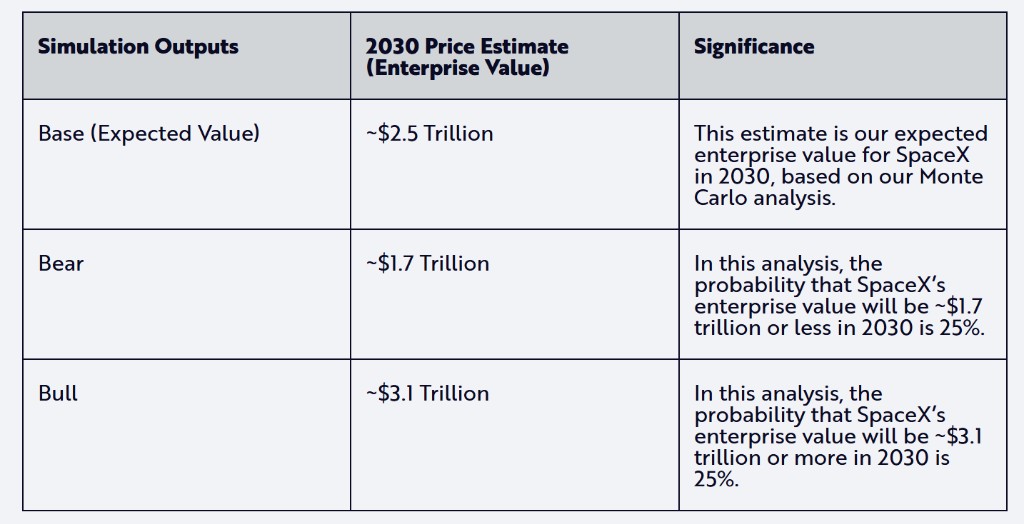
This prediction implies that if we take the company's valuation level of about $350 billion from the last round of financing in December 2024 as a starting point, investors could achieve a compound annual return rate of approximately 38%. According to the Monte Carlo simulation analysis used by ARK, the model also outlines broader possibilities : in an optimistic scenario (75th percentile), the valuation could reach about $3.1 trillion; while in a pessimistic scenario (25th percentile), the valuation would be around $1.7 trillion.

The study also admits that although the predictions are based on one million simulation runs involving 17 key variables, the results are highly dependent on the realization of core assumptions such as the rapid reusability of the "Starship" and the "Optimus" humanoid robot.

However, the deeper significance of the ARK report lies in its systematic breakdown of the "flywheel" logic that supports SpaceX's grand vision—how the massive cash flow generated by the "Starlink" business feeds back into the iteration of "Starship" technology and ultimately lays the foundation for the Mars colonization plan. This open-source model provides a crucial long-term analytical framework for the market to understand SpaceX's transformation from a space company to a builder of "multi-planetary species" infrastructure.

Therefore, from ARK's long-term blueprint in mid-year to the market's immediate enthusiasm at year-end, the story of SpaceX revolves around one core theme: its disruptive technological breakthroughs and commercialization processes are continuously reshaping people's imagination of the value space of this company and the entire aerospace industry.

The following is the original ARK report:

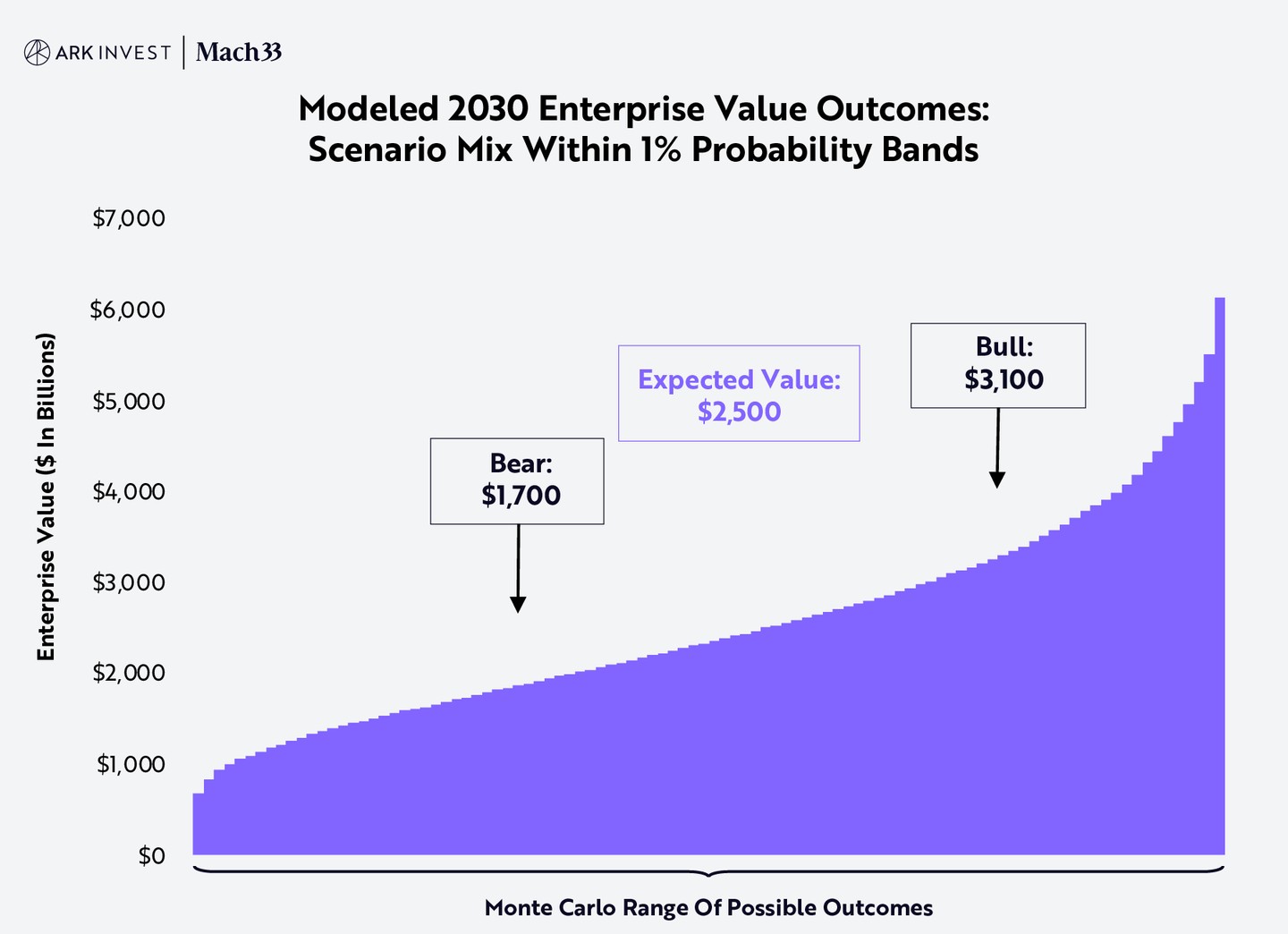
In collaboration with Mach33, ARK's open-source SpaceX model predicts an expected enterprise value of approximately $2.5 trillion by 2030, starting from its last round of financing in December 2024 ($350 billion), with an annual compound return rate of about 38%. Our bullish and bearish predictions correspond to the Monte Carlo simulation results at the 75th percentile and 25th percentile, approximately $3.1 trillion and $1.7 trillion, respectively, as shown below

Source: ARK Investment Management LLC, 2025. For the convenience of readers, this article lists the "expected" (or "benchmark"), "bear market," and "bull market" scenarios separately to clarify our expectations for valuations in 2030. Methodologically, we derive the benchmark valuation by averaging 1 million simulation results generated by a Monte Carlo model. The bear market and bull market scenarios correspond to the 25th and 75th percentile values, respectively. The forecasts themselves have limitations and should not be used as the basis for investment decisions; they are based on our model, reflecting our preferences and long-term positive outlook on the company.

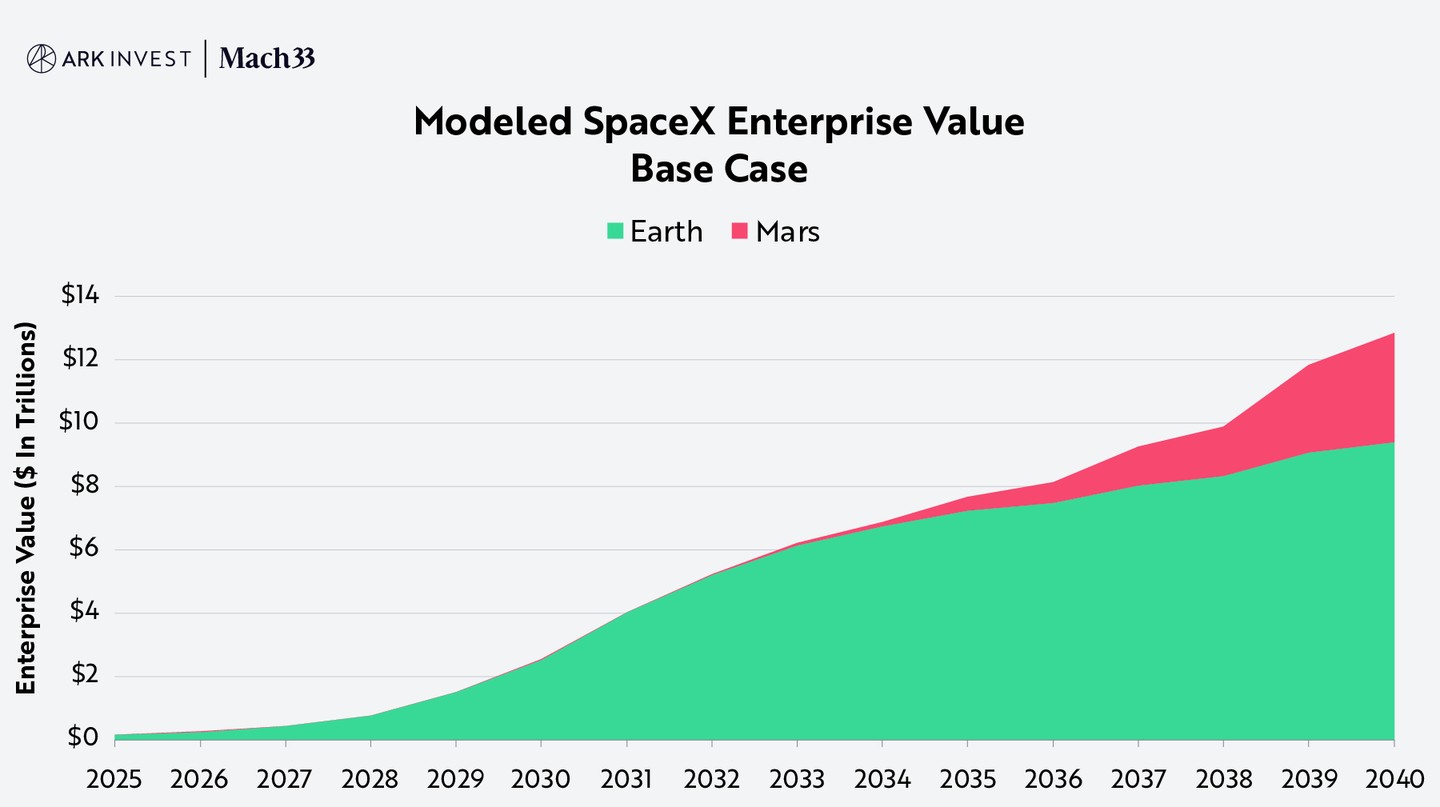
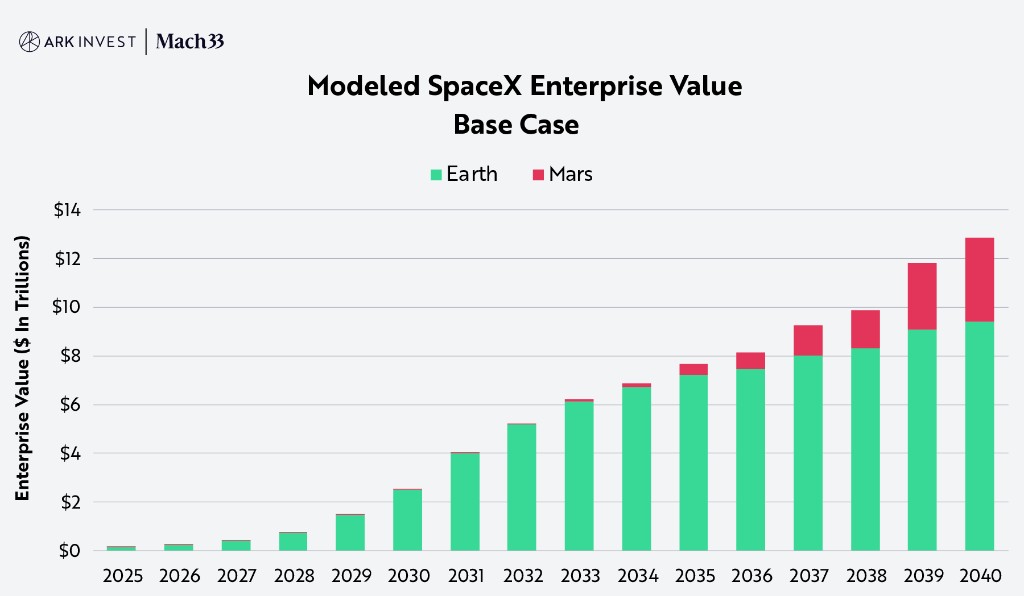
Our open-source model includes 17 key independent inputs to simulate a range of potential outcomes for SpaceX, including the Mars exploration program and its enterprise value in 2030 and 2040, as shown below.

Note: The enterprise value (EV) on Earth is calculated based on our projected EBITDA. Multiplying by an 18x EBITDA to EV ratio is consistent with the industry average for aerospace and defense companies, according to Stern. The enterprise value on Mars reflects the cumulative cash designated for Mars development plus the book value of the infrastructure built by SpaceX on Mars. Source: ARK Investment Management LLC and Mach33, 2025. This analysis uses a range of external data up to May 29, 2025, which can be provided upon request. This analysis is for reference only and should not be considered investment advice or a recommendation to buy, sell, or hold any specific securities. The forecasts themselves have limitations and should not be used as the basis for investment decisions, and they are based on our model reflecting our preferences and long-term positive outlook on the company.

Source: ARK Investment Management LLC and Mach33, 2025. This analysis is based on a range of external data sources up to May 29, 2025, which can be provided in full upon request This analysis is for reference only and should not be considered as investment advice or a recommendation to buy, sell, or hold any specific securities. Predictions have inherent limitations and cannot serve as the basis for investment decisions, and are based on our own models, reflecting our long-term positive outlook on the company.

We will detail our model in the following seven sections:

  • Model Logic
  • Total Addressable Market (TAM) and Unit Economics
  • Satellite Performance
  • Starship and Wright's Law
  • Mars Game Plan
  • Risks and Limitations of the Model and Its Assumptions
  • Conclusion

Model Logic

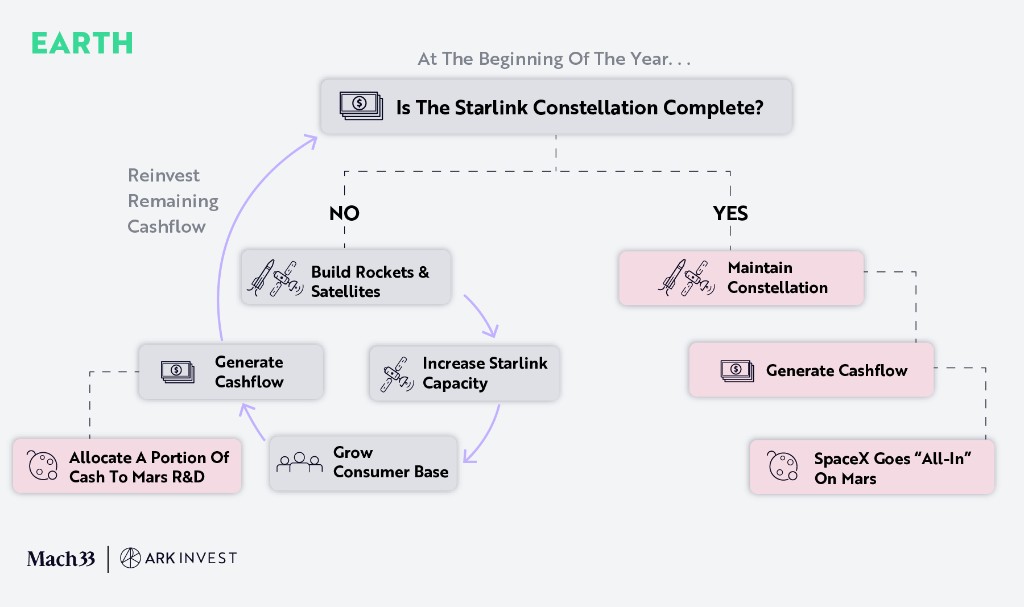
From an analytical perspective, the model operates like a self-reinforcing flywheel, as shown in the diagram below: starting with cash, SpaceX manufactures rockets and satellites, creates orbital bandwidth, acquires Starlink users, and reinvests the generated cash. As the cycle continues, funds gradually flow towards Mars development until the Starlink constellation is fully deployed.

Source: ARK Investment Management LLC and Mach33, 2025. For illustrative purposes only. Predictions have inherent limitations and cannot serve as the basis for investment decisions, and are based on models reflecting our own biases and long-term optimistic views of the company.

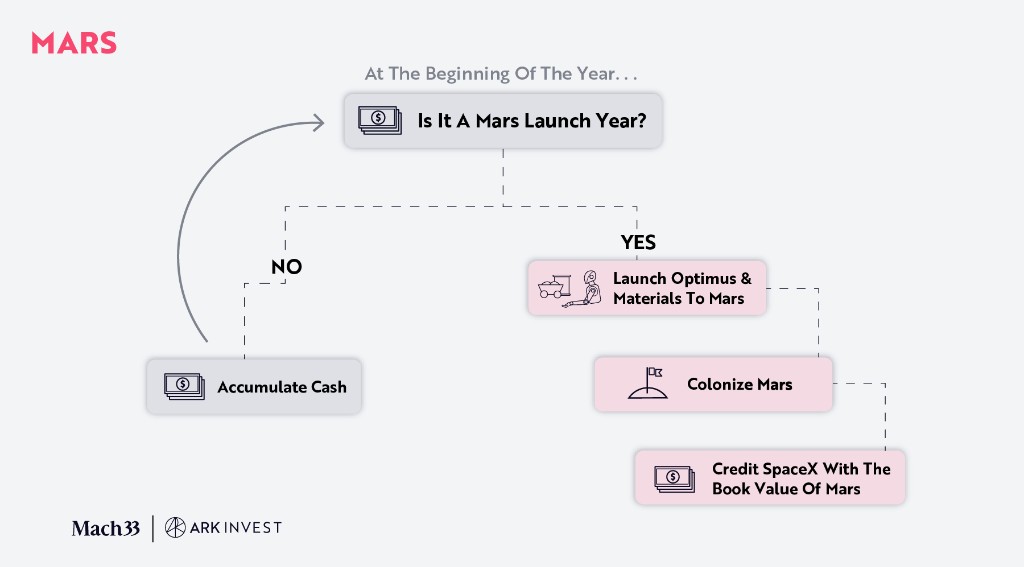
After the Starlink constellation is completed, we assume SpaceX will maintain the constellation's operations and then increase investments in Mars. Each rocket heading to Mars carries a combination of Optimus humanoid robots and materials. Assuming Optimus's productivity improves over time and costs decrease, SpaceX will establish its "book value" on Mars, as shown below.

Source: ARK Investment Management LLC and Mach33, 2025. For illustrative purposes only. Predictions have inherent limitations and cannot serve as the basis for investment decisions, and are based on models reflecting our own biases and long-term optimistic views of the company.

Total Addressable Market (TAM) and Unit Economics

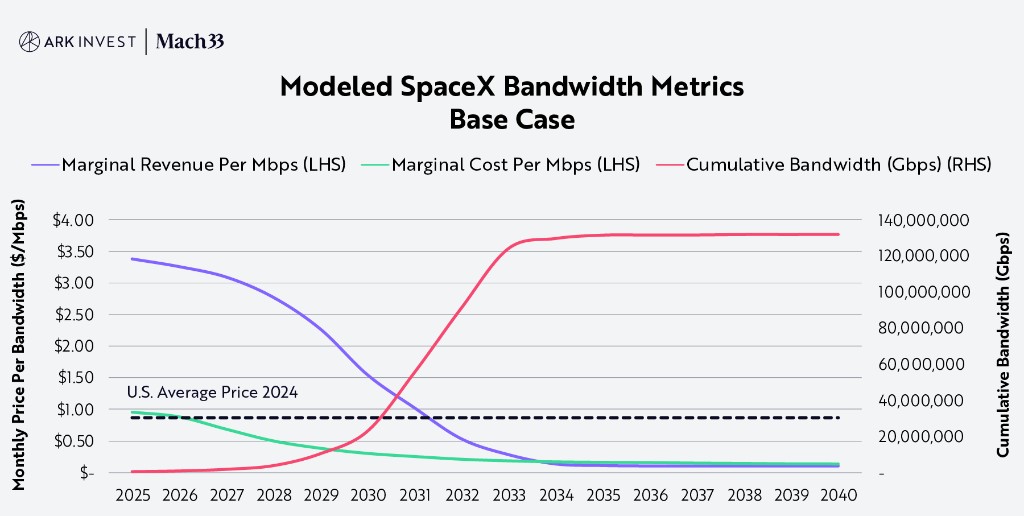
Our top-down open-source satellite broadband revenue demand model (link) allocates SpaceX's revenue based on available bandwidth, the number of people covered, and the acceptable broadband prices and speeds in various countries. Monte Carlo simulations indicate that its bandwidth averages around 130 million gigabits per second (Gbps) at saturation, beyond which increasing bandwidth becomes uneconomical. The breakeven point occurs at approximately $0.20 per month per megabit per second (Mbps), about 75% lower than the current average in the United States, as shown below.

Note: The average price in the United States is for reference only; the monthly marginal revenue per Mbps (purple line) is based on our top-down model's global figures. Source: ARK Investment Management LLC and Mach33, 2025. This analysis uses a range of external data sources up to May 29, 2025, available upon request. This document is for informational purposes only and should not be considered investment advice or a recommendation to buy, sell, or hold any specific securities. Predictions have inherent limitations and should not be used as the basis for investment decisions, and are based on models reflecting our own biases and long-term optimistic views of the company.

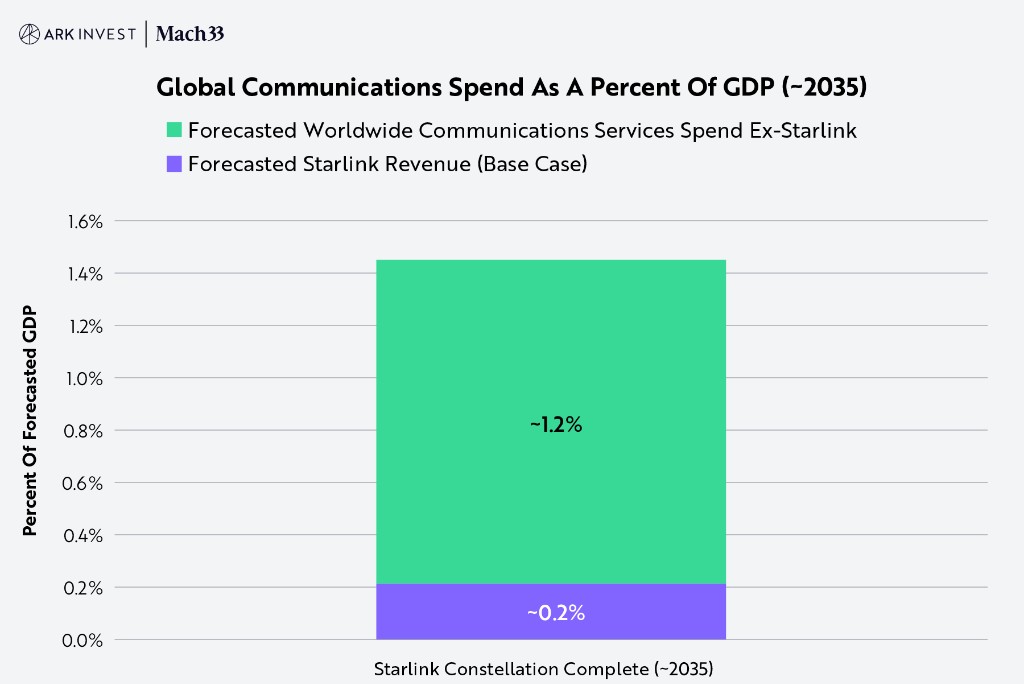
According to our baseline scenario, after the Starlink constellation is completed around 2035, ARK research shows that SpaceX could generate approximately $300 billion in annual revenue, accounting for about 15% of total global communications spending, as shown below.

Source: ARK Investment Management LLC and Mach33, 2025, based on data from the World Bank and Gartner as of May 29, 2025. This document is for informational purposes only and should not be considered investment advice or a recommendation to buy, sell, or hold any specific securities. Predictions have inherent limitations and should not be used as the basis for investment decisions, and are based on models reflecting our own biases and long-term optimistic views of the company.

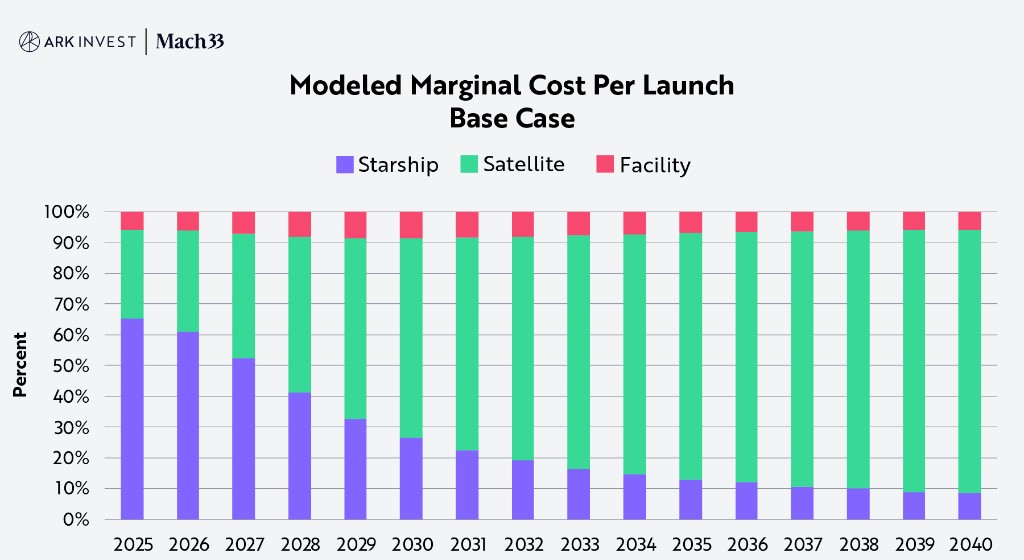
A close examination of the marginal costs in the Monte Carlo simulation reveals that as the reusability of Starship increases, the proportion of satellites in total marginal costs rises from about 30% to about 90% over time, as shown below.

Source: ARK Investment Management LLC and Mach33, 2025. This analysis uses a range of external data sources up to May 29, 2025, available upon request. This document is for informational purposes only and should not be considered investment advice or a recommendation to buy, sell, or hold any specific securities. Predictions have inherent limitations and should not be used as the basis for investment decisions, and are based on models reflecting our own biases and long-term optimistic views of the company.

Therefore, satellite performance measured in Gbps/kg becomes the most sensitive input variable in the model, affecting revenue generation and capital expenditures. Satellite performance is crucial for the efficiency and cost of bandwidth deployment and is key to determining the speed at which SpaceX completes the construction of the Starlink constellation and shifts its capital focus to Mars objectives.

Satellite Performance

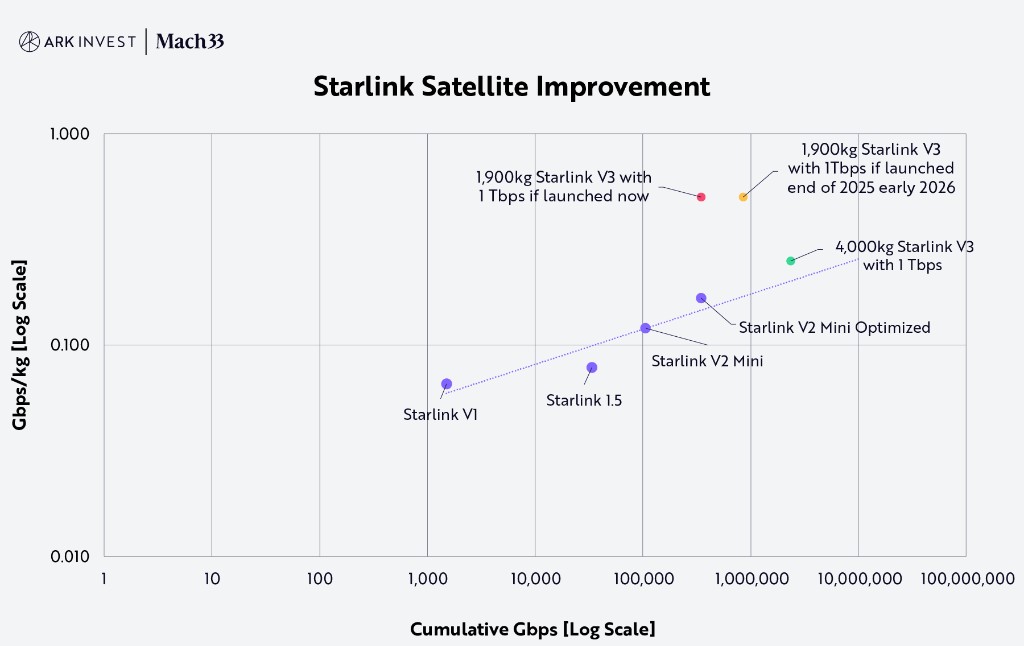
From V1 to V2 Mini Optimized, Starlink satellite performance has consistently followed Wright's Law learning curve. SpaceX has submitted documents to the U.S. Federal Communications Commission regarding the next generation of satellites, weighing approximately 2000 kg, and mentioned 1 Tbps bandwidth in another disclosure about future satellites If these specifications apply to the same satellite, the performance leap would be significant, as indicated by the red and yellow points in the figure below. However, our research suggests that these two disclosures may point to different satellites. If so, the 1Tbps satellite would be consistent with the Law of Wright, as shown by the green point in the figure below.

Source: ARK Investment Management LLC, 2025, based on SpaceX data as of May 29, 2025. This article is for informational purposes only and should not be considered investment advice or a recommendation to buy, sell, or hold any specific securities. Predictions have inherent limitations.

Starship and the Law of Wright

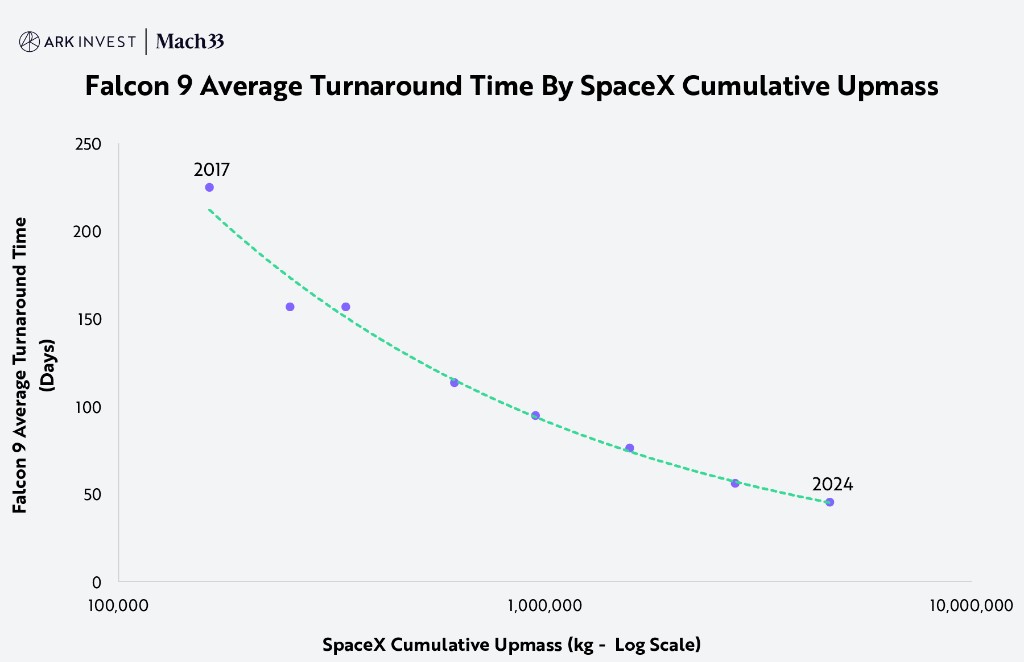
Starship is central to multi-planetary living. Although the upfront capital costs are high, the turnaround time and reusability of Starship are crucial to its operations. As the reusability of Starship continues to improve, fewer vehicles and more frequent launch cycles should be able to deliver the same upward mass. Based on Falcon 9 data, the Law of Wright indicates that for every doubling of cumulative orbital upward mass, the turnaround time of Starship will decrease at a constant rate of about 27%, as shown below.

Source: ARK Investment Management LLC, 2025, based on SpaceX data as of May 29, 2025. This article is for informational purposes only and should not be considered investment advice or a recommendation to buy, sell, or hold any specific securities.

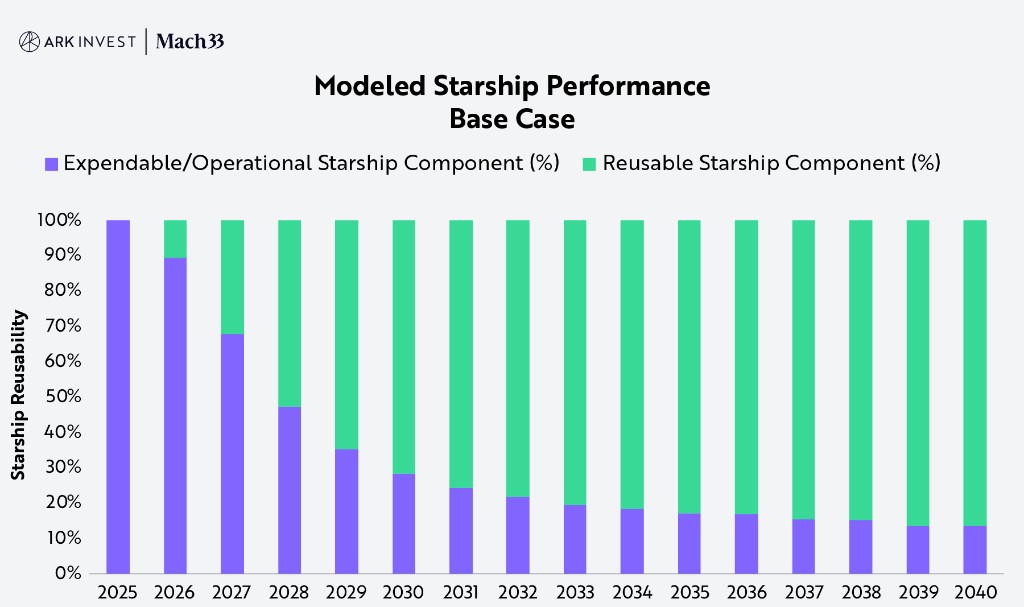
We believe that minimizing rocket turnaround time and improving reusability are essential for maintaining the economic viability of SpaceX's constellation and advancing its Mars ambitions. Therefore, our model shows that rocket reusability increases in tandem with cumulative upward mass, as shown below.

Note: According to the model, even with rapid reusability achieved, the reusable components of Starship will never reach 100%, as there will always be variable costs associated with each launch, such as fuel. Source: ARK Investment Management LLC and Mach33, 2025. This analysis uses a range of external data sources as of May 29, 2025, available upon request. This article is for informational purposes only and should not be considered investment advice or a recommendation to buy, sell, or hold any specific securities. Predictions have inherent limitations and should not be used as the basis for investment decisions, and are based on models reflecting our own biases and long-term optimistic views of the company

Mars Planning

Elon Musk founded SpaceX with the goal of achieving multi-planetary living, particularly enabling humanity to migrate to Mars with the help of its other companies. We believe that Elon has been designing the Optimus robot and Boring Company equipment to build infrastructure for challenging extraterrestrial environments to support Mars colonization.

According to our research, the proportion of Mars in SpaceX's enterprise value will grow over time, as shown below. However, while capital improvements related to Mars will be accounted for on SpaceX's balance sheet, their associated cash flows will be more speculative than those of Starlink.

Source: ARK Investment Management LLC and Mach33, 2025. This analysis uses a range of external data sources as of May 29, 2025, available upon request. This document is for informational purposes only and should not be considered investment advice or a recommendation to buy, sell, or hold any specific securities. Predictions have inherent limitations and should not be used as the basis for investment decisions, and are based on models reflecting our own biases and long-term optimistic views of the company.

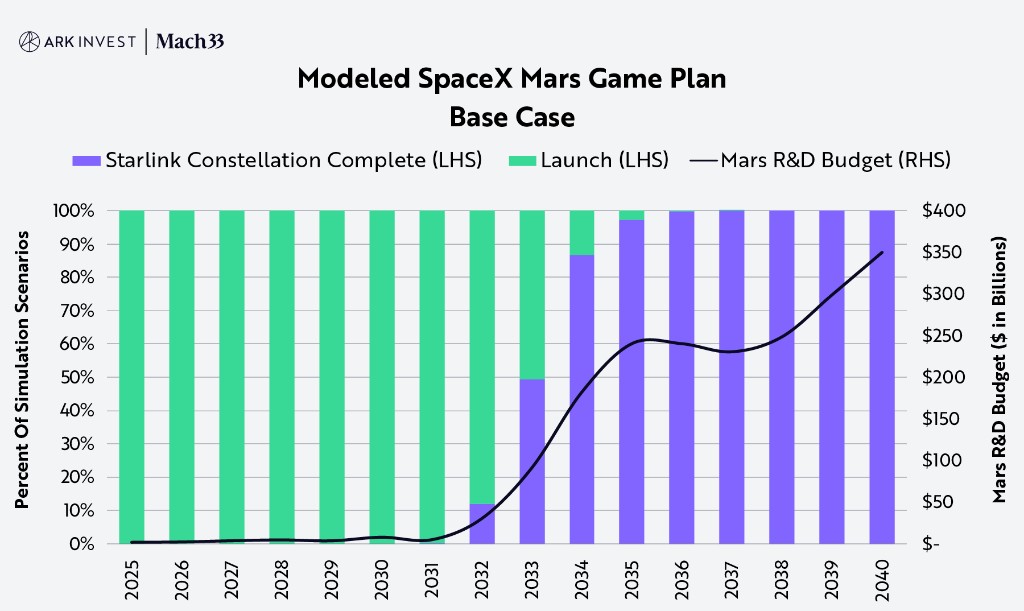
Therefore, our model assumes that before the completion of the Starlink constellation, SpaceX will allocate only a small portion of its budget to Mars. Once this milestone is reached, SpaceX may redirect its Starlink resources towards Mars, as shown below. Given the scale and long-term goals of colonizing Mars, investors may not see much capital return for a considerable period. Although Mars activities may reduce costs in the Earth satellite market and pave the way for asteroid mining, these opportunities are beyond the scope of this forecast.

Source: ARK Investment Management LLC and Mach33, 2025. This analysis uses a range of external data sources as of May 29, 2025, available upon request. This document is for informational purposes only and should not be considered investment advice or a recommendation to buy, sell, or hold any specific securities. Predictions have inherent limitations and should not be used as the basis for investment decisions, and are based on models reflecting our own biases and long-term optimistic views of the company.

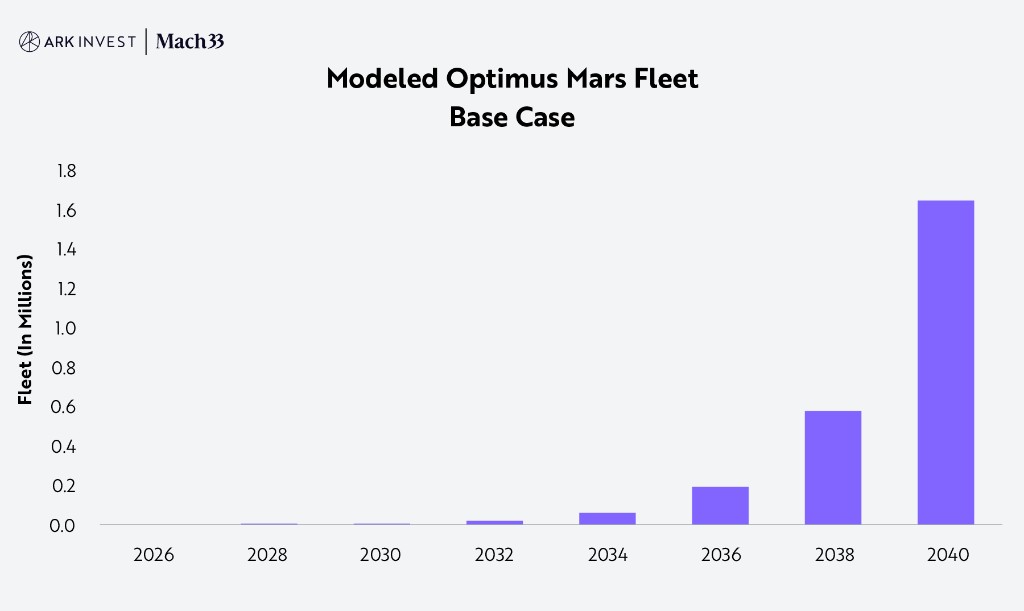
Our Monte Carlo simulation assumes that Starship will carry a combination of Optimus robots (Optimi) modified for Mars, with their numbers growing to millions over time, as shown below. According to the model, Optimi will build infrastructure to support permanent colonies, with their productivity improving over time. The payloads supporting early human habitation may be quite complex. Our partner Mach33 has analyzed the potential costs of early Mars payloads (link). In the early stages, the contribution of human payloads on Mars to SpaceX's book value may be minimal

Source: ARK Investment Management LLC and Mach33, 2025. This analysis utilizes a range of external data sources as of May 29, 2025, available upon request. This document is for informational purposes only and should not be construed as investment advice or a recommendation to buy, sell, or hold any specific securities. Predictions inherently have limitations and should not be used as the basis for investment decisions, as they are based on models reflecting our own biases and long-term optimistic views of the company.

Model and Our Assumptions on Risks and Limitations

ARK's 17 key independent variables cover what we believe to be reasonable scenarios for SpaceX in the coming years. Unexpected events, such as Elon Musk's sudden departure from the company, or natural disasters or pandemics, could significantly impact these outcomes. Additionally, space is inherently a challenging field with significant execution risks. If Starship fails to achieve rapid reusability, it could severely affect the value we forecast for the company. Similarly, there is no guarantee that Optimus will be able to support infrastructure development within the timeline set in the model, and given the time constraints of interplanetary launch windows, delays could lead to significant setbacks. Finally, increased competition could reduce the total addressable market for broadband, while changes in government spending could impact the revenue potential of Starshield